Showing posts with label Isaac Asimov. Show all posts

Tuesday, January 19, 2016

The currents of space (Written by Isaac Asimov) - Published in 1952

Isaac Asimov was a prolific writer, somebody who write fiction and non-fiction in vast numbers, starting with writing science fiction stories that magazines would scoop up (although sometimes if one magazine rejected it, another would take it). He has even written science textbooks, and during a period in his career, was so interested in writing non-fiction books that he practically stopped writing his science fiction. Over his long career, he is most famous for 2 specific series of science fiction books, these being the books about robots (in fact, there is this logical set of laws called The three laws of robotics that he introduced in his books), and the Foundation series (about a massive galactic empire of the future, and how it starts to fail because it is too big and full of inertia, and needs to be replaced by The Foundation).
The Currents of Space is one of his early novels, having been published in 1952, before the first spaceship went into orbit and before a lot of research into space had really been conducted. Although it is to be said, Asimov's novels are not so much about science fiction as they are about describing societal behavior of human societies of the future, their problems, their evolution, and so on. If you read these books and love them, you will love all the Asimov books, even the ones which are not his best (such as The Currents of Space),


Part of the future as per Asimov is where mankind has gone through several rounds of settlement in planets outside the solar system, with society either using robots or totally staying away from robots. Now, millions of world have been settled, and the Galactic Empire, based at Trantor as the center, is slowly forming, absorbing worlds in order to grow. There are planets which are independent, although there are political games happening between Trantor and these planets. One of these planets is Sark, which rules another planet called Florina. The reason to keep Florina subjugated is that for some reason, a wonderful fiber called 'kyrt', grows here, and here only. All attempts to grow it elsewhere to the level found on Florina have failed. Continued capture of Florina ensures that Sark has the market for 'kyrt' and earns massively. Sark has setup a captive bureaucracy on Florina and rules with an iron hand (this entire set is based on the concept of Southern slave-owners having slaves to work on their cotton fields).
The novel starts with a person trying to communicate a major discovery, but is captured and a psychic probe is applied, which ensures that the person will reveal their secret, but also loses a large portion of mental capacity and becomes like a child. That is Rik, who is found on Florina and is struggling to get mental capacity back. A girl in Florina takes care of him, even though she works in a mill and has quotas to meet, helped by a local Florinan official, who seemingly works for Sark. The story spins further and further, with Sark trying to determine exactly what is happening, agents for Trantor trying to put their own finger here, and the ever growing memory of Rik and his realization that something serious is about to happen to Florina.
Read this novel; it's not very long but is decently interesting.
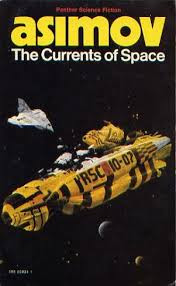
The currents of space (Written by Isaac Asimov) - Published in 1952

Thursday, June 18, 2015

The Stars, Like Dust (Published in 1951) - Authored by Isaac Asimov - Not regarded as one of his better novels

This novel is different from the other novels of Asimov; for one, there is a lot more action (if you read the Foundation or even the Robot novels, there is a lot more play of society, of thought, of classes, of intrigue, but not so much action). However, at the same time, it is not really a very strong novel; if you read it, you might think some lesser writer had written it as compared to the author who wrote the original Foundation novel at approximately the same time.
Isaac Asimov was an incredibly prolific author. Over the years, he has written a massive number of book, but he is not only a science fiction write. For many years in between, he was also involved in writing a large number of non-fiction books, and this period saw him write very few science fiction, being more involved in writing these books. However, he is more known for his science fiction writing, and more specifically for the Foundation Series as well as the Laws of Robotics that were present through his books. Even though we do not have the kind of robots that he introduced in his books, the same ethical debates about the capabilities of robots that we produce is based on the discussion of the 3 Laws of Robotics.


One of the problems of his different stages of writing these books was that he would try to stitch the same thread and history in the books he had. However, stitching this book into his future chronology was always going to be difficult. For those familiar with the Foundation, this book was about a time period before the establishment of the Galactic empire founded on Trantor, and Earth is known (which it is not known any more during the Galactic empire).
Actually, the plot of the novel can make the head spin a bit. It is about conspiracies, and quests to escape the tyranny of a particular set of people, called, wait for it, the Tyranni (because they come from the planet Tyrann). They control a set of 50 planets, located near the Horsehead Nebula, and one way to ensure that these plants remain in their control is by limiting the amount of knowledge of science and space travel in this area.
The hero of the novel is Biron Farrill, who is studying at University, and whose father, a powerful leader, called the Lord Rancher of Widemos, was executed by the Tyranni, and how his own life would be in danger, and in fact, there apparently is an attempt on his life. He is advised to travel to one of the captured planet called Rhodia, and after that, his life is a series of dueling and escaping from the Tyranni and their agents. A lot of their quest is for a rebellion world, where there is the seeds of a rebellion against the Tyranni and which they must find, while they are being chased so that the rebellious world can be found and the rebellion stopped. And so on, but the end of the novel is disappointing.

The Stars, Like Dust (Published in 1951) - Authored by Isaac Asimov - Not regarded as one of his better novels

Friday, June 28, 2013

Novel - The Positronic Man (published in 1992) - Written by Isaac Asimov

Isaac Asimov is one of the most famous authors of science fiction, but he is not just a writer of science fiction. He wrote on a number of subjects, and was the author of a large number of science books, not only fiction. Asimov had an interesting life, born in the late 1919, or early 1920 in Russia and then his parents moved to the United States when he was only 3 years old. His moved to the Brooklyn area of New York, and that is where he grew up. He started writing for science fiction magazines at an early age, and was soon making a good going out of these. He also grew up in a age where there was worries about science and inventions, with the Frankenstein complex riding high on the minds of people, especially about the concept of robots (which were not a reality at that point of time). He enunciated over a period of time, the concept of the 3 Laws of robotics, which was a theory about the construction of robots such that they would always be subservient to humans, and would not act in a way that would be out of control. And then he went ahead and wrote stories where there were robots who were unusual, and in some cases, the robots had some tweak where they could be a danger.
The novels and short stories by Asimov were not only science fiction in the classical sense, but they actually talked about societies in the future, whether these be societies living in a cave scenario, people who have never seen the sun and would be frightened to go outside; or there were stories about a society which lives under 3 suns, and has never seen night, so what happens when there is a specific time when all of the suns go down and suddenly the society is faced with night that it has not seen in thousands of years (this was the premise of the book, Nightfall). Asimov also wrote a series of books set way in the future, which formed the Foundation series, another of the series of books for which Asimov is famous.


In one of his short stories "The Bicentennial Man", Asimov wrote about a robot who was different from the other robots of that time. A small modification in the robot had causes this robot to almost have an individuality, and the family that owns that robot was fairly rich and liberal, and encouraged him, almost as a member of the family. Because the robot, Andrew, had some unique artistic skills, he was able to make money out of these skills, and starts to display some properties related to emotion, something that robots were deemed incapable of, properties that seemed to differentiate humans from robots. However, this was not easy; there were many challenges from society, even members of the family could only accept part of his desires. Even the corporation that made him, U.S. Robotics, is puzzled over what gave him this creativity, but they are not comfortable with his quest for getting rights, and even change the structure of their robots to prevent his kind of occurrence.
By now, Andrew has rights, but wants the ultimate right, the right to be recognized like a human being; and for that right, in the end, he makes the ultimate sacrifice; he takes the right to die like humans do. Towards this end, over a period of time, he has replaced many of his body parts with organic parts to gain even more acceptance.

Novel - The Positronic Man (published in 1992) - Written by Isaac Asimov

Friday, June 21, 2013

Novel - Prelude to Foundation (published in 1988) - Written by Isaac Asimov

Isaac Asimov was one of the most prominent writers of science fiction; but he was not just a writer of science fiction, but wrote a lot about science and other subjects, writing a large number of books overall. He was born in the Soviet Union in late 1919 (or early 1920) and moved to the United States with his family when he was just 3 years old and settled in the Brooklyn area of New York. In the United States, at an early age he became fascinated with science fiction and was selling his stories to magazines when he was as young as 19. He continued writing books and articles for the rest of his life, finally dying at the age of 72 in 1992.
He is now mostly known for the books dealing with Robotics (primarily his enunciation of The 3 laws of robotics; which were meant to provide a rulebook for robots so that they would remain under human control) and for his Foundation Trilogy. The Foundation Trilogy was a series of 3 books that described a future galaxy under the control of a Galactic Empire which is decaying, but only one man believes that he knows this. This man is Hari Seldon, who finally created the science of psychohistory, which would enable the foretelling of the future of large groups of people. The idea of Hari Seldon was to prevent the 30,000 years of turmoil and conflict that would emerge at the end of the Galactic Empire and through the creation of 2 Foundations, change this 30,000 year period to a 1,000 year period at which a Second Galactic Empire will create peace in the galaxy.


Prelude to Foundation was a book that Asimov wrote long after he had written the original Foundation Trilogy (Foundation, Foundation and Empire, and Second Foundation), these 3 having been written in the early 1950's, and then Asimov wrote 2 more books called Foundation's Edge and Foundation and Earth in 1982 and 1986. However, Prelude to Foundation was supposed to be a prequel, providing more detail about Hari Seldon and his background, and also about his growth of the study of psychohistory, how he developed it. The books does not have any ground-breaking revelations, it just shows how Hari Seldon moved to different parts of Trantor while trying to figure out how to develop psychohistory.
The book starts with Seldon presenting a paper concerning the basics of psychohistory and how it could be used. This brings him to the attention of the emperor Cleon I, but when Hari cannot promise instant revelations, Cleon dismisses him. And then he meets the people who will be most significant to him - he meets a reporter called Chetter Hummin, who scares Hari by claiming that the all powerful first minister Eto Demerzel is trying to catch him, and he needs to escape. Chetter then introduces him to Dors Venabili (his future wife) and they start on a run through the different sections of the planet, with different societies, on the run from Eto while Hari is trying to determine a section of society that can form the base for his research. He moves through different sections of Trantor in his flight, meeting very different societies, and even ending up with a powerful sector that is forever looking to replace the emperor. Who is Eto, why is Chetter helping him ? All of these are powerful questions for which Hari Seldon gets answers at the end of the novel.

Novel - Prelude to Foundation (published in 1988) - Written by Isaac Asimov

Wednesday, June 5, 2013

Novel - Robots and Empire - A book by Isaac Asimov (published in 1985)

Isaac Asimov was a prolific writer of books, which included both science fiction and non-fiction science related books. Over the years, he has become extremely famous for the numerous science fiction novels he wrote, and the way he wrote about societies of the future. His societies of the future have a certain tinge of familiarity with the society that we can see now, but he also showcases societies which seem extremely warped in terms of how they operate (especially when you see the societies that he has described in the Spacer worlds).
Asimov was born in Russia and moved at a very early age to the US and settled down in the Brooklyn area of New York. Although he was associated with different universities including Columbia and Boston University and even spent some time in the army (having been drafted), his heart was always in writing. He became a contributor to the famous science fiction magazines of the time, and also moved into writing science rather than science fiction. Isaac Asimov is most famous for the series of short stories and novels he wrote on Robots (and played his part in removing the Frankenstein complex about Robots through his Three Laws of Robotics - although the development of military robots seems totally contrary to these law of robots and seems more fueled towards the Terminator kind of world).
He also wrote a series of books that are collectively known as the Foundation Series (the first three of which came in the early 1950's and the remainder were written after a period of 30 years). They explore a period in which the massive Galactic Empire that has kept peace in the Galaxy is decaying and will eventually die, causing a prolonged period of anarchy and a scientist attempts to reduce this time period to a much smaller interval.


The novel is the 4th novel in the series, starting with the The Caves of Steel, The Naked Sun, and The Robots of Dawn. The main difference between these 3 novels and this one is the non-presence of the team of Elijab Baley and his humanoid robotic partner, R. Daneel Olivaw. The time period is set around 2 centuries after the previous novel, which means that Elijab Baley is no longer on the scene, having died as per human timelines. However, the lady he met in 2 of the previous novels, Gladia Delmarre, is still alive since she is a spacer and spacers have developed a much longer lifeline than that of humans.
But there has been a great transition in the overall balance of power in the galaxy. In the time of Elijah, the spacers were very powerful while earth was a much weaker source of power. However, the movement started by Elijah and a few others and supported by the faction of spacers led by Dr. Han Fastolfe, who wanted the settlement of the galaxy to be done by humans rather than using humanoid robots, grew wings and the humans started spreading outwards, outpacing the spacer worlds and using the huge population of earth to settle new worlds.
Even though Dr. Fastolfe had died, his enemies were still in place and could not digest what was happening, and were not able to withstand the increasing number of worlds being populated by human settlers. They want to destroy Earth in a way that is not traced back to the spacers and they believe that this will ensure that earth is not able to achieve its aims. In all this, is present a descendant of Elijah Baley, called Daneel Giskard Baley, who is part of these groups of settlers. He wants the help of Gladia for help in figuring out why her now abandoned planet of Solaria is destroying spaceships that land there, and also wants to recover the robots that are now there, apparently without any owners. Gladia decides to help, and gets Giskard and Daneel (with their super strength) as companions.
The former opponent of Dr. Fastolfe, Kelden Amadiro has got a new supporter and helper, Levular Mandamus. Till now, Giskard has been able to use his telepathic powers to stop all efforts by Amadiro to stop earth, and now he and Daneel have to proceed on their most difficult fight as yet, the effort to stop Amadiro and Mandamus from destroying earth through an increase in radioactivity (the net result of which was displayed in a mostly radioactive earth, in Pebble in the Sky). However, while trying to stay in line with the Three Laws of Robotics while trying to stop these 2 is a big challenge, and Asimov tries to get more inventive, trying to create a Zeroth law of Robotics, which places humanity above individual humans, but this effort places a huge impact on the minds of the robots and causes a breakup of the minds of Giskard. And the earth does become radioactive, but not in a few years, but over the next 150 years.
Asimov tried to use this novel to link his robotic series with his Foundation series, using Daneel in the last of the Foundation series and also introducing the worlds of the spacers as dead worlds.


Novel - Robots and Empire - A book by Isaac Asimov (published in 1985)

Sunday, June 2, 2013

Novel - The Robots of Dawn - Isaav Asimov (published in 1983)

Isaac Asimov is known as one of the masters of science fiction, but he was more than just a writer of science fiction. In addition to science fiction, he wrote a science books and with a total book collection (books that he would have written or edited) in the hundreds. His books came out in a time when there were many other authors of science fiction, but Asimov has always been counted among the top writers in his field, along with other authors such as Arthur C Clarke and Robert A Heinlein.
Some of the most famous works of Asimov includes the Foundation Series (which takes a look at society during and after a massive galactic empire came to an end), and also includes the science of psychohistory (that seems to predict the future based on large masses of people, but is not usable on small scales). In addition to this, Asimov is also very famous for his many books on robotics, some of them set on their own and others in terms of their involvement with non-earth societies at a time when they were shunned on earth.
He is also very famous for his 3 laws of robotics which seek to provide safeguards on the actions of robots and prevent them from behaving in a Frankenstein manner.
And of course Asimov was also famous for his short story Nightfall, which took a society which has always every had light in its sky, and how it reacts when it knows that all those suns that light up the sky will vanish for a period of time and there will be night (a concept that people have never had).


Robots of Dawn is the next novel in the series of the earth-based plainclothes detective Elijah Baley (with the earlier novels in this series being 'The Caves of Steel' and 'The Naked Sun'). So far, the interaction with the spacers and with robots (primarily the detective partner, the humanoid R Daneel Olivaw) has led to changes in the attitudes of Elijah. He has started believing that it is the future of humanity to move out and occupy planets rather than the spacers doing so. For this, they have to start moving out from their caves of steel and become more comfortable with open spaces and with being under the sun. So, far because Elijah has been successful in his past investigations, he has managed to gain fame and also enabled some rights for earth.
But each time, he faces investigations where there is a lot at stake. If he fails, not only will he face demotion, but earth will also lose out. And now he is getting into a murder investigation where there is a lot more at stake. There is a tussle going on on the world of Aurora, which is seen as the chief spacer world, and where there are groups which are fighting a power struggle over whether new worlds would be settled by spacers or by people from earth. The group favoring spacers wants to use humaniform robots (which look exactly like humans / spacers) but the technology for them is only available with the robotist Dr. Hans Fastolfe. And the murder is that of one of the 2 humaniform robots in existence, R. Jander Parnell.
Because of the skill needed to create a mental block in such a robot, Dr. Fastolfe is the one who is blamed for the crime, and he himself admits that only he has the abilities, but that he did not do it. However, if he is proved guilty, then his faction will lose power and the group advocating spacers doing the resettlement using robots will win. And into this mess is inserted Elijah Baley, and since the winning of Dr. Fastolfe's group is so important to earth, he is again under a lot of pressure. He is partnered with R. Daneel Olivaw again, and this time, he comes into contact with another robot, not a humaniform robot through, with the name of Giskard.
So starts the investigation, and Elijah comes across a number of people, some in favor, and some against him But because he is doing the investigation of this important case, they also have to give him an audience. He comes into contact with a person from the previous book, Gladia Delmarre, who had the robot in her staff, and who had also taken the robot as her sexual partner and treated him like her husband.
How does Elijah Baley overcome all the problems placed in his path ? Does he manage to prevent Dr. Fastolfe from being proven guilty ? How did the robot get a mental block which effectively killed the robot.

Novel - The Robots of Dawn - Isaav Asimov (published in 1983)

Sunday, April 28, 2013

Novel - The Caves of Steel - Isaav Asimov (published in 1954)


Isaac Asimov is one of the most famous science fiction writers of all time. The number of fiction and non-fiction books that he has written number in the hundreds, more than 500 books of different genres. Asimov is mostly famous for his science fiction novels, but he has written a number of others books, almost all of them on science. Along with other authors such as Arthur C Clarke and others such as Robert Heinlein, he was one of the most famous science fiction writers of all time. His most famous legacies include the 3 laws of Robotics (meant to ensure that humans have control over robots) and for the Foundation series of books. For many science fiction readers, Asimov would have been the first author whose books they may have read. He had also won many of the science fiction awards that were there, and one of his short stories, Nightfall was very popular with critics. For those who have read the books, there are many aspects of the books that are not science fiction per se, instead they are a beautiful description of the society of the future.
Asimov was born as a Russian Jew in the period just after the First World War, with the exact date of birth unknown (sometime between 1919 and 1920). When Asimov was very young, his family moved to the United States and settled in New York. During the Second World War, he was working in a Navy station stateside, and joined the Boston University School of Medicine. He started writing short stories in 1939, and also with novels in 1950. Within a couple of years, he also went into writing non-fiction books. Over a period of time, he wrote a large number of books, with an increasing concentration on science books rather than non-fiction. In fact, as he mentioned in the Foundation Series, he had to be literally forced by his publishers to write some of the later Foundation books. Unfortunately, after writing a huge collection of books, many of them incredible books, Isaac Asimov died in 1992.
The Caves of Steel was the first in a series of novels that starred the human investigator Elijah Baley and his humanoid robotic partner, Daneel Olivaw. The book was first published as a series in Galaxy Magazine, over the last quarter of 1953, with the hardcover editing being published in 1954. This was the book that showed a time when travelers from earth (using hyperdrive) managed to colonize external planets. However, these colonizers, over a period of time managed to control disease, developed the science to live much longer and grew very rich, comfortable with robots to help them with their lives. At the same time, on earth, there was a reverse process. Humans retreated into living in large cities of steel (and an aversion to open space or outside), with severe restrictions and control on all facilities, hating those who had gone outside (the Spacers) and hating the control they had on earth, and most of all hating their machines, the robots.


In this setting, Elijah Baley is a policeman, with some of these biases as well. He has a family, and due to his status as a policeman, he has some facilities that others don't have, but there are many that he does not have because of his current rank. And then, a disaster occurs. A Spacer, one who wants people on earth to start going outside again, to other worlds, is killed just inside Spacetown (the guarded location on earth where Spacers live, and where people from earth are only allowed after being disinfected). He has been killed using a blaster, but it is a proper murder mystery since it is not easy to detect as to who did the murder. The disaster and opportunity for Elijah is that his boss, the Commissioner, wants Elijah to take up the murder investigation, and his partner will be a robot who looks just like a human, called R. Daneel Olivaw (the R stands for Robot).
There is no evidence of how the murder occurred and it is now upto Elijah to do all the investigations to figure out why the murder occurred. He has to fight with unknown people, work against an organization that wants nothing to do with Spacers and with robots and is looking to implicate Elijah in a situation where he will be accused of destroying valuable property. How does he do it ? Is he successful ?


Novel - The Caves of Steel - Isaav Asimov (published in 1954)

Monday, April 22, 2013

Novel - The Naked Sun - Isaav Asimov (published in 1957)

Isaac Asimov is one of the most famous science fiction writers of all time. The number of fiction and non-fiction books that he has written number in the hundreds, more like 500 books. Although Asimov is mostly famous for his science fiction novels, he has written a number of books on science. Along with Arthur C Clarke and others such as Robert Heinlein, he was one of the most famous science fiction writers of all time, most famous now for the 3 laws of Robotics and for the Foundation series of books. For many science fiction readers, Asimov would have been the first author whose books they may have read. He had also won many of the science fiction awards that were there, and one of his short stories, Nightfall was very popular with critics. For those who have read the books, there are many aspects of the books that are not science fiction per se, instead they are a beautiful description of the society of the future.
Asimov was born as a Russian Jew in the period just after the First World War, with the exact date of birth unknown (sometime between 1919 and 1920). When Asimov was very young, his family moved to the United States and settled in New York. During the Second World War, he was working in a Navy station stateside, and joined the Boston University School of Medicine. He started writing short stories in 1939, and also with novels in 1950. Within a couple of years, he also went into writing non-fiction books. Over a period of time, he wrote a large number of books, with an increasing concentration on science books rather than non-fiction. In fact, as he mentioned in the Foundation Series, he had to be literally forced by his publishers to write some of the later Foundation books. Unfortunately, Isaac Asimov died in 1992.
The Naked Sun was published in a magazine between October and December 1956 and was published in a complete form in 1957. It takes off from an earlier novel, the Caves of Steel, continuing with the same societal issues and the same set of characters, exploring the strange forms of society formed on Earth and on one of the Other worlds which was settled by people from Earth, and where society developed in such a way that people avoided contact with each other.

In the Caves of Steel, Elijah Baley was introduced to his partner, the humaniform robot R. Daneel Olivaw. Earth is the cradle of humanity but has started to live in massive caves, cut off from the sunlight, from the open air (in fact, people are almost never exposed to sunlight and would be scared and horrified if they did get exposed to such sunlight). In addition, there are vast powerful new worlds that were settled by people who moved out from Earth. These people are called spacers, who have lived in worlds where all forms of infections have been controlled, where they have eliminated the normal diseases which affect the people on earth. As a result, they have drastically increased their life spans, and also become much more powerful and capable of destroying earth and its people as well. But since they are no longer exposed to these diseases, they no longer have the same kind of immunity, and hence avoid any kind of connection to the people of earth; if they have to meet them, the person from earth needs to be disinfected, and the Spacers wear nose filters as well. Earthlings also have a strong distaste for Robots, not being able to stand being near them. In the worlds that the Spacers inhabit, their populations are far lower, and there is no such distaste for robots. They know how to utilize the robots, and use them for making their life better. However, with these comforts, their need for social interaction decreases, to the extent that on worlds such as Solaria, people live on vast estates, with a large number of robots (approximately 10,000 robots for every one person), and yet cannot stand to be in the physical presence of other people. They meet each other through video interactions and shun the company of others. The population is also controlled for the exact number that is seemed right for each estate. Elijah Baley is now famous ever since he managed to resolve the murder that happened in Spacetown on earth along with Daneel, and hence has been called for the investigation of the murder of a famous fetologist and robotocist, Rikaine Delmarre on Solaria. This assignment is significant, since with the power equations, any failure of Elijah can be very dangerous for Elijah and for Earth, but success can increase the power of those Spacers in favor of Earth. He is again partnered with R. Daneel Olivaw, and now has to work in an environment where many Solarians look down upon him and consider him as an inferior person. The main suspect in the case is that of the wife of Rikaine, Gladia. The book is an interesting murder mystery, set in a time when Elijah cannot even visit the various people involved in the case but has to view them from a distance. Further, he has to delve deeper into the 3 laws of Robotics, and how any changes in these laws can cause murder to happen, and what this means for the future. I really loved the book, and am not going to reveal more of the story. It is a must read from my perspective. I don't consider such a book dated even though it was published more than 50 years back.

The Naked Sun - a novel by Isaac Asimov, published in 1957