Showing posts with label Science Fiction. Show all posts

Tuesday, January 19, 2016

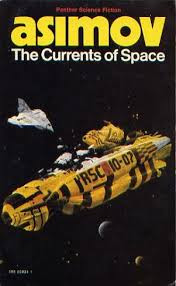
The currents of space (Written by Isaac Asimov) - Published in 1952

Isaac Asimov was a prolific writer, somebody who write fiction and non-fiction in vast numbers, starting with writing science fiction stories that magazines would scoop up (although sometimes if one magazine rejected it, another would take it). He has even written science textbooks, and during a period in his career, was so interested in writing non-fiction books that he practically stopped writing his science fiction. Over his long career, he is most famous for 2 specific series of science fiction books, these being the books about robots (in fact, there is this logical set of laws called The three laws of robotics that he introduced in his books), and the Foundation series (about a massive galactic empire of the future, and how it starts to fail because it is too big and full of inertia, and needs to be replaced by The Foundation).
The Currents of Space is one of his early novels, having been published in 1952, before the first spaceship went into orbit and before a lot of research into space had really been conducted. Although it is to be said, Asimov's novels are not so much about science fiction as they are about describing societal behavior of human societies of the future, their problems, their evolution, and so on. If you read these books and love them, you will love all the Asimov books, even the ones which are not his best (such as The Currents of Space),


Part of the future as per Asimov is where mankind has gone through several rounds of settlement in planets outside the solar system, with society either using robots or totally staying away from robots. Now, millions of world have been settled, and the Galactic Empire, based at Trantor as the center, is slowly forming, absorbing worlds in order to grow. There are planets which are independent, although there are political games happening between Trantor and these planets. One of these planets is Sark, which rules another planet called Florina. The reason to keep Florina subjugated is that for some reason, a wonderful fiber called 'kyrt', grows here, and here only. All attempts to grow it elsewhere to the level found on Florina have failed. Continued capture of Florina ensures that Sark has the market for 'kyrt' and earns massively. Sark has setup a captive bureaucracy on Florina and rules with an iron hand (this entire set is based on the concept of Southern slave-owners having slaves to work on their cotton fields).
The novel starts with a person trying to communicate a major discovery, but is captured and a psychic probe is applied, which ensures that the person will reveal their secret, but also loses a large portion of mental capacity and becomes like a child. That is Rik, who is found on Florina and is struggling to get mental capacity back. A girl in Florina takes care of him, even though she works in a mill and has quotas to meet, helped by a local Florinan official, who seemingly works for Sark. The story spins further and further, with Sark trying to determine exactly what is happening, agents for Trantor trying to put their own finger here, and the ever growing memory of Rik and his realization that something serious is about to happen to Florina.
Read this novel; it's not very long but is decently interesting.
The currents of space (Written by Isaac Asimov) - Published in 1952

Thursday, June 18, 2015

The Stars, Like Dust (Published in 1951) - Authored by Isaac Asimov - Not regarded as one of his better novels

This novel is different from the other novels of Asimov; for one, there is a lot more action (if you read the Foundation or even the Robot novels, there is a lot more play of society, of thought, of classes, of intrigue, but not so much action). However, at the same time, it is not really a very strong novel; if you read it, you might think some lesser writer had written it as compared to the author who wrote the original Foundation novel at approximately the same time.
Isaac Asimov was an incredibly prolific author. Over the years, he has written a massive number of book, but he is not only a science fiction write. For many years in between, he was also involved in writing a large number of non-fiction books, and this period saw him write very few science fiction, being more involved in writing these books. However, he is more known for his science fiction writing, and more specifically for the Foundation Series as well as the Laws of Robotics that were present through his books. Even though we do not have the kind of robots that he introduced in his books, the same ethical debates about the capabilities of robots that we produce is based on the discussion of the 3 Laws of Robotics.


One of the problems of his different stages of writing these books was that he would try to stitch the same thread and history in the books he had. However, stitching this book into his future chronology was always going to be difficult. For those familiar with the Foundation, this book was about a time period before the establishment of the Galactic empire founded on Trantor, and Earth is known (which it is not known any more during the Galactic empire).
Actually, the plot of the novel can make the head spin a bit. It is about conspiracies, and quests to escape the tyranny of a particular set of people, called, wait for it, the Tyranni (because they come from the planet Tyrann). They control a set of 50 planets, located near the Horsehead Nebula, and one way to ensure that these plants remain in their control is by limiting the amount of knowledge of science and space travel in this area.
The hero of the novel is Biron Farrill, who is studying at University, and whose father, a powerful leader, called the Lord Rancher of Widemos, was executed by the Tyranni, and how his own life would be in danger, and in fact, there apparently is an attempt on his life. He is advised to travel to one of the captured planet called Rhodia, and after that, his life is a series of dueling and escaping from the Tyranni and their agents. A lot of their quest is for a rebellion world, where there is the seeds of a rebellion against the Tyranni and which they must find, while they are being chased so that the rebellious world can be found and the rebellion stopped. And so on, but the end of the novel is disappointing.

The Stars, Like Dust (Published in 1951) - Authored by Isaac Asimov - Not regarded as one of his better novels

Friday, June 28, 2013

Novel - The Positronic Man (published in 1992) - Written by Isaac Asimov

Isaac Asimov is one of the most famous authors of science fiction, but he is not just a writer of science fiction. He wrote on a number of subjects, and was the author of a large number of science books, not only fiction. Asimov had an interesting life, born in the late 1919, or early 1920 in Russia and then his parents moved to the United States when he was only 3 years old. His moved to the Brooklyn area of New York, and that is where he grew up. He started writing for science fiction magazines at an early age, and was soon making a good going out of these. He also grew up in a age where there was worries about science and inventions, with the Frankenstein complex riding high on the minds of people, especially about the concept of robots (which were not a reality at that point of time). He enunciated over a period of time, the concept of the 3 Laws of robotics, which was a theory about the construction of robots such that they would always be subservient to humans, and would not act in a way that would be out of control. And then he went ahead and wrote stories where there were robots who were unusual, and in some cases, the robots had some tweak where they could be a danger.
The novels and short stories by Asimov were not only science fiction in the classical sense, but they actually talked about societies in the future, whether these be societies living in a cave scenario, people who have never seen the sun and would be frightened to go outside; or there were stories about a society which lives under 3 suns, and has never seen night, so what happens when there is a specific time when all of the suns go down and suddenly the society is faced with night that it has not seen in thousands of years (this was the premise of the book, Nightfall). Asimov also wrote a series of books set way in the future, which formed the Foundation series, another of the series of books for which Asimov is famous.


In one of his short stories "The Bicentennial Man", Asimov wrote about a robot who was different from the other robots of that time. A small modification in the robot had causes this robot to almost have an individuality, and the family that owns that robot was fairly rich and liberal, and encouraged him, almost as a member of the family. Because the robot, Andrew, had some unique artistic skills, he was able to make money out of these skills, and starts to display some properties related to emotion, something that robots were deemed incapable of, properties that seemed to differentiate humans from robots. However, this was not easy; there were many challenges from society, even members of the family could only accept part of his desires. Even the corporation that made him, U.S. Robotics, is puzzled over what gave him this creativity, but they are not comfortable with his quest for getting rights, and even change the structure of their robots to prevent his kind of occurrence.
By now, Andrew has rights, but wants the ultimate right, the right to be recognized like a human being; and for that right, in the end, he makes the ultimate sacrifice; he takes the right to die like humans do. Towards this end, over a period of time, he has replaced many of his body parts with organic parts to gain even more acceptance.

Novel - The Positronic Man (published in 1992) - Written by Isaac Asimov

Saturday, June 22, 2013

Novel - The Hammer of God - Written by Arthur C Clarke (published in 1992)

Arthur C Clarke was one of the most eminent writers in the field of science fiction. I have been a fan of both Clarke and Asimov for a long time and have read many of their books, admiring many of them for their futuristic view of society, and of trying to draw visions of what the society of the future will look like, not only on the earth, but in other environments as well. For example, the Rama series takes the culture that gets established in a large alien cylindrical spaceship (and such an environment is not easy to think about). Arthur C Clarke was most famous for his work along with Stanley Kubrick on the incredible 2001: A Space Odyssey, which was written as a novel, and was also made into a fascinating movie.
Arthur C Clarke grew up as a boy in England, and then served through the Second World War in the Royal Air Force in the radar area, and left the service after the war to join King's College in London. He also was the Chairman of the British interplanetary service for 2 terms till 1953, but it was even before this time period, in the period just after the war had ended that he postulated the idea of the stationary geosynchronous orbit being ideal for placing of telecommunications satellites and in his honor, this orbit is named after him. He also wrote more about space flight and the rockets that would be used. He is now most famous for the 2001 inspired series, and for the Rama series, both of which won a lot of awards. In 1956, Clarke moved to Sri Lanka, inspired by his interest in scuba diving.


The Hammer of God is a novel set in the future,  where a large asteroid is heading for earth, destined to become a killer of humanity. The asteroid is called Kali, and is detected by a program called Spaceguard, meant to protect the earth by deflecting an asteroid, not through the huge explosives that you see in movies called Deep Impact or Armageddon, but instead by placing a huge amount of fuel on the asteriod along with a rocket that would change the course of the asteroid by a small amount on a regular basis, but this course correction over the many weeks would change the trajectory of the asteroid enough to cause it miss the earth (this is one of the measures that are being investigated to prevent the earth from being hit by large asteroids). Of course, this would also be because the novel projects an earth which has rid itself of nuclear weapons.
The spacecraft which is spearheading this mission is called Goliath, meant to be in space along with a sister ship called Titan (located on opposite sides of the earth) - and the creation of this program was also created only after a tragedy happened to one of the advocated of the program. However, this simple program was meant to fail, since, there was a new religion on earth, conveniently called Chrislam (a combination of Christmas and Islam), which believed that God's purpose was not be opposed, and if a asteroid was meant to destroy the earth, so bet it. This would not mean the end of humanity, since there were settlements on the moon and on mars, but it would be an awful calamity; hence, they caused the destruction of the fuel tanks that would have caused the asteroid to change its course. What happens next ? Can the Goliath prevent the asteroid from hitting the earth and destroying all life ?


Novel - The Hammer of God - Written by Arthur C Clarke (published in 1992)

Friday, June 21, 2013

Novel - Prelude to Foundation (published in 1988) - Written by Isaac Asimov

Isaac Asimov was one of the most prominent writers of science fiction; but he was not just a writer of science fiction, but wrote a lot about science and other subjects, writing a large number of books overall. He was born in the Soviet Union in late 1919 (or early 1920) and moved to the United States with his family when he was just 3 years old and settled in the Brooklyn area of New York. In the United States, at an early age he became fascinated with science fiction and was selling his stories to magazines when he was as young as 19. He continued writing books and articles for the rest of his life, finally dying at the age of 72 in 1992.
He is now mostly known for the books dealing with Robotics (primarily his enunciation of The 3 laws of robotics; which were meant to provide a rulebook for robots so that they would remain under human control) and for his Foundation Trilogy. The Foundation Trilogy was a series of 3 books that described a future galaxy under the control of a Galactic Empire which is decaying, but only one man believes that he knows this. This man is Hari Seldon, who finally created the science of psychohistory, which would enable the foretelling of the future of large groups of people. The idea of Hari Seldon was to prevent the 30,000 years of turmoil and conflict that would emerge at the end of the Galactic Empire and through the creation of 2 Foundations, change this 30,000 year period to a 1,000 year period at which a Second Galactic Empire will create peace in the galaxy.


Prelude to Foundation was a book that Asimov wrote long after he had written the original Foundation Trilogy (Foundation, Foundation and Empire, and Second Foundation), these 3 having been written in the early 1950's, and then Asimov wrote 2 more books called Foundation's Edge and Foundation and Earth in 1982 and 1986. However, Prelude to Foundation was supposed to be a prequel, providing more detail about Hari Seldon and his background, and also about his growth of the study of psychohistory, how he developed it. The books does not have any ground-breaking revelations, it just shows how Hari Seldon moved to different parts of Trantor while trying to figure out how to develop psychohistory.
The book starts with Seldon presenting a paper concerning the basics of psychohistory and how it could be used. This brings him to the attention of the emperor Cleon I, but when Hari cannot promise instant revelations, Cleon dismisses him. And then he meets the people who will be most significant to him - he meets a reporter called Chetter Hummin, who scares Hari by claiming that the all powerful first minister Eto Demerzel is trying to catch him, and he needs to escape. Chetter then introduces him to Dors Venabili (his future wife) and they start on a run through the different sections of the planet, with different societies, on the run from Eto while Hari is trying to determine a section of society that can form the base for his research. He moves through different sections of Trantor in his flight, meeting very different societies, and even ending up with a powerful sector that is forever looking to replace the emperor. Who is Eto, why is Chetter helping him ? All of these are powerful questions for which Hari Seldon gets answers at the end of the novel.

Novel - Prelude to Foundation (published in 1988) - Written by Isaac Asimov

Wednesday, June 5, 2013

Novel - Robots and Empire - A book by Isaac Asimov (published in 1985)

Isaac Asimov was a prolific writer of books, which included both science fiction and non-fiction science related books. Over the years, he has become extremely famous for the numerous science fiction novels he wrote, and the way he wrote about societies of the future. His societies of the future have a certain tinge of familiarity with the society that we can see now, but he also showcases societies which seem extremely warped in terms of how they operate (especially when you see the societies that he has described in the Spacer worlds).
Asimov was born in Russia and moved at a very early age to the US and settled down in the Brooklyn area of New York. Although he was associated with different universities including Columbia and Boston University and even spent some time in the army (having been drafted), his heart was always in writing. He became a contributor to the famous science fiction magazines of the time, and also moved into writing science rather than science fiction. Isaac Asimov is most famous for the series of short stories and novels he wrote on Robots (and played his part in removing the Frankenstein complex about Robots through his Three Laws of Robotics - although the development of military robots seems totally contrary to these law of robots and seems more fueled towards the Terminator kind of world).
He also wrote a series of books that are collectively known as the Foundation Series (the first three of which came in the early 1950's and the remainder were written after a period of 30 years). They explore a period in which the massive Galactic Empire that has kept peace in the Galaxy is decaying and will eventually die, causing a prolonged period of anarchy and a scientist attempts to reduce this time period to a much smaller interval.


The novel is the 4th novel in the series, starting with the The Caves of Steel, The Naked Sun, and The Robots of Dawn. The main difference between these 3 novels and this one is the non-presence of the team of Elijab Baley and his humanoid robotic partner, R. Daneel Olivaw. The time period is set around 2 centuries after the previous novel, which means that Elijab Baley is no longer on the scene, having died as per human timelines. However, the lady he met in 2 of the previous novels, Gladia Delmarre, is still alive since she is a spacer and spacers have developed a much longer lifeline than that of humans.
But there has been a great transition in the overall balance of power in the galaxy. In the time of Elijah, the spacers were very powerful while earth was a much weaker source of power. However, the movement started by Elijah and a few others and supported by the faction of spacers led by Dr. Han Fastolfe, who wanted the settlement of the galaxy to be done by humans rather than using humanoid robots, grew wings and the humans started spreading outwards, outpacing the spacer worlds and using the huge population of earth to settle new worlds.
Even though Dr. Fastolfe had died, his enemies were still in place and could not digest what was happening, and were not able to withstand the increasing number of worlds being populated by human settlers. They want to destroy Earth in a way that is not traced back to the spacers and they believe that this will ensure that earth is not able to achieve its aims. In all this, is present a descendant of Elijah Baley, called Daneel Giskard Baley, who is part of these groups of settlers. He wants the help of Gladia for help in figuring out why her now abandoned planet of Solaria is destroying spaceships that land there, and also wants to recover the robots that are now there, apparently without any owners. Gladia decides to help, and gets Giskard and Daneel (with their super strength) as companions.
The former opponent of Dr. Fastolfe, Kelden Amadiro has got a new supporter and helper, Levular Mandamus. Till now, Giskard has been able to use his telepathic powers to stop all efforts by Amadiro to stop earth, and now he and Daneel have to proceed on their most difficult fight as yet, the effort to stop Amadiro and Mandamus from destroying earth through an increase in radioactivity (the net result of which was displayed in a mostly radioactive earth, in Pebble in the Sky). However, while trying to stay in line with the Three Laws of Robotics while trying to stop these 2 is a big challenge, and Asimov tries to get more inventive, trying to create a Zeroth law of Robotics, which places humanity above individual humans, but this effort places a huge impact on the minds of the robots and causes a breakup of the minds of Giskard. And the earth does become radioactive, but not in a few years, but over the next 150 years.
Asimov tried to use this novel to link his robotic series with his Foundation series, using Daneel in the last of the Foundation series and also introducing the worlds of the spacers as dead worlds.


Novel - Robots and Empire - A book by Isaac Asimov (published in 1985)

Sunday, June 2, 2013

Novel - The Robots of Dawn - Isaav Asimov (published in 1983)

Isaac Asimov is known as one of the masters of science fiction, but he was more than just a writer of science fiction. In addition to science fiction, he wrote a science books and with a total book collection (books that he would have written or edited) in the hundreds. His books came out in a time when there were many other authors of science fiction, but Asimov has always been counted among the top writers in his field, along with other authors such as Arthur C Clarke and Robert A Heinlein.
Some of the most famous works of Asimov includes the Foundation Series (which takes a look at society during and after a massive galactic empire came to an end), and also includes the science of psychohistory (that seems to predict the future based on large masses of people, but is not usable on small scales). In addition to this, Asimov is also very famous for his many books on robotics, some of them set on their own and others in terms of their involvement with non-earth societies at a time when they were shunned on earth.
He is also very famous for his 3 laws of robotics which seek to provide safeguards on the actions of robots and prevent them from behaving in a Frankenstein manner.
And of course Asimov was also famous for his short story Nightfall, which took a society which has always every had light in its sky, and how it reacts when it knows that all those suns that light up the sky will vanish for a period of time and there will be night (a concept that people have never had).


Robots of Dawn is the next novel in the series of the earth-based plainclothes detective Elijah Baley (with the earlier novels in this series being 'The Caves of Steel' and 'The Naked Sun'). So far, the interaction with the spacers and with robots (primarily the detective partner, the humanoid R Daneel Olivaw) has led to changes in the attitudes of Elijah. He has started believing that it is the future of humanity to move out and occupy planets rather than the spacers doing so. For this, they have to start moving out from their caves of steel and become more comfortable with open spaces and with being under the sun. So, far because Elijah has been successful in his past investigations, he has managed to gain fame and also enabled some rights for earth.
But each time, he faces investigations where there is a lot at stake. If he fails, not only will he face demotion, but earth will also lose out. And now he is getting into a murder investigation where there is a lot more at stake. There is a tussle going on on the world of Aurora, which is seen as the chief spacer world, and where there are groups which are fighting a power struggle over whether new worlds would be settled by spacers or by people from earth. The group favoring spacers wants to use humaniform robots (which look exactly like humans / spacers) but the technology for them is only available with the robotist Dr. Hans Fastolfe. And the murder is that of one of the 2 humaniform robots in existence, R. Jander Parnell.
Because of the skill needed to create a mental block in such a robot, Dr. Fastolfe is the one who is blamed for the crime, and he himself admits that only he has the abilities, but that he did not do it. However, if he is proved guilty, then his faction will lose power and the group advocating spacers doing the resettlement using robots will win. And into this mess is inserted Elijah Baley, and since the winning of Dr. Fastolfe's group is so important to earth, he is again under a lot of pressure. He is partnered with R. Daneel Olivaw again, and this time, he comes into contact with another robot, not a humaniform robot through, with the name of Giskard.
So starts the investigation, and Elijah comes across a number of people, some in favor, and some against him But because he is doing the investigation of this important case, they also have to give him an audience. He comes into contact with a person from the previous book, Gladia Delmarre, who had the robot in her staff, and who had also taken the robot as her sexual partner and treated him like her husband.
How does Elijah Baley overcome all the problems placed in his path ? Does he manage to prevent Dr. Fastolfe from being proven guilty ? How did the robot get a mental block which effectively killed the robot.

Novel - The Robots of Dawn - Isaav Asimov (published in 1983)

Sunday, April 28, 2013

Novel - The Caves of Steel - Isaav Asimov (published in 1954)


Isaac Asimov is one of the most famous science fiction writers of all time. The number of fiction and non-fiction books that he has written number in the hundreds, more than 500 books of different genres. Asimov is mostly famous for his science fiction novels, but he has written a number of others books, almost all of them on science. Along with other authors such as Arthur C Clarke and others such as Robert Heinlein, he was one of the most famous science fiction writers of all time. His most famous legacies include the 3 laws of Robotics (meant to ensure that humans have control over robots) and for the Foundation series of books. For many science fiction readers, Asimov would have been the first author whose books they may have read. He had also won many of the science fiction awards that were there, and one of his short stories, Nightfall was very popular with critics. For those who have read the books, there are many aspects of the books that are not science fiction per se, instead they are a beautiful description of the society of the future.
Asimov was born as a Russian Jew in the period just after the First World War, with the exact date of birth unknown (sometime between 1919 and 1920). When Asimov was very young, his family moved to the United States and settled in New York. During the Second World War, he was working in a Navy station stateside, and joined the Boston University School of Medicine. He started writing short stories in 1939, and also with novels in 1950. Within a couple of years, he also went into writing non-fiction books. Over a period of time, he wrote a large number of books, with an increasing concentration on science books rather than non-fiction. In fact, as he mentioned in the Foundation Series, he had to be literally forced by his publishers to write some of the later Foundation books. Unfortunately, after writing a huge collection of books, many of them incredible books, Isaac Asimov died in 1992.
The Caves of Steel was the first in a series of novels that starred the human investigator Elijah Baley and his humanoid robotic partner, Daneel Olivaw. The book was first published as a series in Galaxy Magazine, over the last quarter of 1953, with the hardcover editing being published in 1954. This was the book that showed a time when travelers from earth (using hyperdrive) managed to colonize external planets. However, these colonizers, over a period of time managed to control disease, developed the science to live much longer and grew very rich, comfortable with robots to help them with their lives. At the same time, on earth, there was a reverse process. Humans retreated into living in large cities of steel (and an aversion to open space or outside), with severe restrictions and control on all facilities, hating those who had gone outside (the Spacers) and hating the control they had on earth, and most of all hating their machines, the robots.


In this setting, Elijah Baley is a policeman, with some of these biases as well. He has a family, and due to his status as a policeman, he has some facilities that others don't have, but there are many that he does not have because of his current rank. And then, a disaster occurs. A Spacer, one who wants people on earth to start going outside again, to other worlds, is killed just inside Spacetown (the guarded location on earth where Spacers live, and where people from earth are only allowed after being disinfected). He has been killed using a blaster, but it is a proper murder mystery since it is not easy to detect as to who did the murder. The disaster and opportunity for Elijah is that his boss, the Commissioner, wants Elijah to take up the murder investigation, and his partner will be a robot who looks just like a human, called R. Daneel Olivaw (the R stands for Robot).
There is no evidence of how the murder occurred and it is now upto Elijah to do all the investigations to figure out why the murder occurred. He has to fight with unknown people, work against an organization that wants nothing to do with Spacers and with robots and is looking to implicate Elijah in a situation where he will be accused of destroying valuable property. How does he do it ? Is he successful ?


Novel - The Caves of Steel - Isaav Asimov (published in 1954)

Monday, April 22, 2013

Novel - The Naked Sun - Isaav Asimov (published in 1957)

Isaac Asimov is one of the most famous science fiction writers of all time. The number of fiction and non-fiction books that he has written number in the hundreds, more like 500 books. Although Asimov is mostly famous for his science fiction novels, he has written a number of books on science. Along with Arthur C Clarke and others such as Robert Heinlein, he was one of the most famous science fiction writers of all time, most famous now for the 3 laws of Robotics and for the Foundation series of books. For many science fiction readers, Asimov would have been the first author whose books they may have read. He had also won many of the science fiction awards that were there, and one of his short stories, Nightfall was very popular with critics. For those who have read the books, there are many aspects of the books that are not science fiction per se, instead they are a beautiful description of the society of the future.
Asimov was born as a Russian Jew in the period just after the First World War, with the exact date of birth unknown (sometime between 1919 and 1920). When Asimov was very young, his family moved to the United States and settled in New York. During the Second World War, he was working in a Navy station stateside, and joined the Boston University School of Medicine. He started writing short stories in 1939, and also with novels in 1950. Within a couple of years, he also went into writing non-fiction books. Over a period of time, he wrote a large number of books, with an increasing concentration on science books rather than non-fiction. In fact, as he mentioned in the Foundation Series, he had to be literally forced by his publishers to write some of the later Foundation books. Unfortunately, Isaac Asimov died in 1992.
The Naked Sun was published in a magazine between October and December 1956 and was published in a complete form in 1957. It takes off from an earlier novel, the Caves of Steel, continuing with the same societal issues and the same set of characters, exploring the strange forms of society formed on Earth and on one of the Other worlds which was settled by people from Earth, and where society developed in such a way that people avoided contact with each other.

In the Caves of Steel, Elijah Baley was introduced to his partner, the humaniform robot R. Daneel Olivaw. Earth is the cradle of humanity but has started to live in massive caves, cut off from the sunlight, from the open air (in fact, people are almost never exposed to sunlight and would be scared and horrified if they did get exposed to such sunlight). In addition, there are vast powerful new worlds that were settled by people who moved out from Earth. These people are called spacers, who have lived in worlds where all forms of infections have been controlled, where they have eliminated the normal diseases which affect the people on earth. As a result, they have drastically increased their life spans, and also become much more powerful and capable of destroying earth and its people as well. But since they are no longer exposed to these diseases, they no longer have the same kind of immunity, and hence avoid any kind of connection to the people of earth; if they have to meet them, the person from earth needs to be disinfected, and the Spacers wear nose filters as well. Earthlings also have a strong distaste for Robots, not being able to stand being near them. In the worlds that the Spacers inhabit, their populations are far lower, and there is no such distaste for robots. They know how to utilize the robots, and use them for making their life better. However, with these comforts, their need for social interaction decreases, to the extent that on worlds such as Solaria, people live on vast estates, with a large number of robots (approximately 10,000 robots for every one person), and yet cannot stand to be in the physical presence of other people. They meet each other through video interactions and shun the company of others. The population is also controlled for the exact number that is seemed right for each estate. Elijah Baley is now famous ever since he managed to resolve the murder that happened in Spacetown on earth along with Daneel, and hence has been called for the investigation of the murder of a famous fetologist and robotocist, Rikaine Delmarre on Solaria. This assignment is significant, since with the power equations, any failure of Elijah can be very dangerous for Elijah and for Earth, but success can increase the power of those Spacers in favor of Earth. He is again partnered with R. Daneel Olivaw, and now has to work in an environment where many Solarians look down upon him and consider him as an inferior person. The main suspect in the case is that of the wife of Rikaine, Gladia. The book is an interesting murder mystery, set in a time when Elijah cannot even visit the various people involved in the case but has to view them from a distance. Further, he has to delve deeper into the 3 laws of Robotics, and how any changes in these laws can cause murder to happen, and what this means for the future. I really loved the book, and am not going to reveal more of the story. It is a must read from my perspective. I don't consider such a book dated even though it was published more than 50 years back.

The Naked Sun - a novel by Isaac Asimov, published in 1957

Wednesday, October 27, 2010

Plain tales from the hills (published in 1888) - Written by Rudyard Kipling

Rudyard Kipling, a Nobel laureate was born in India to a vivacious Alice Kipling and sculptor Painter, John Kipling. His works range from poems, to children's books. Rudyard was a English language writer whose prose is peppered with colloquial usage and languages mainly from India which opens a window to the prevailing culture and customs of the time. His children's stories are the most endured classics of the time and his short stories are the most sought after. Many of his works are deemed to be controversial as the time progressed. Rudyard Kipling was the product of an imperial India where imperialism under Queen Victoria was at its heights. His poems like "White Mans Burden" are often sited as a clarion call for the imperialist and has been criticized by subsequent humanist. But as one of the youngest Nobel Prize recipient for English Language, the place for Kipling in human history cannot be discounted and his prose and poems enthuse millions even today.
Plain stories from the hills are a collection of short stories penned by Kipling during his stay in India as a journalist. Out of the 40 stories, about 15 to 20 of them were published in the Civil and Military gazette, the paper for which Kipling worked for and the rest were new ones. These stories depict the various facets of life in imperial India, the lives of the natives and the English Sahibs. He often puts up a satirical look on the ways and behavior of the English who treat the natives like untouchables.


Many of the stories are set in Shimla which used to be the summer capital of British India. Most of the Englishmen would shift to the hill station to escape from the heat of the plains. Here the traditions of British India along with the Indian elite produced a different world itself. The stories also are set up among the natives who are portrayed in a simple fashion and in the plains of India.
Here his recurring characters namely Mrs Hauksbee, Policeman Strickland and the Soldiers three appear. The most common refrain of Mrs Hauksbee who cannot suffer stupidity "What fools men are!" starts from this book. The tales include Lispeth,Three and - an Extra, Thrown Away, Miss Youghal's Sais, Yoked with an Unbeliever, False Dawn, The Rescue of Pluffles Cupid's Arrows, The Three Musketeers, "His Chance in Life", Watches of the Night, "The Other Man", Consequences, The Conversion of Aurelian McGoggin, The Taking of Lungtungpen, A Germ-Destroyer, Kidnapped, The Arrest of Lieutenant Golightly, In the House of Suddhoo, His Wedded Wife, The Broken-link Handicap, Beyond the Pale, In Error, A Bank Fraud, Tod's' Amendment, The Daughter of the Regiment, In the Pride of his Youth, Pig, The Rout of the White Hussars, The Bronckhorst Divorce-case, Venus Annodomini, The Bisra of Pooree, A Friend's Friend, The Gate of the Hundred Sorrows, The Madness of Private Ortheris, The Story of Muhammad Din, On the Strength of a Likeness, Wressley of the Foreign Office, By Word of Mouth, To be Filed for Reference
My personal favorite is Miss Youghal's Sais, which tells the story of the class divide. Strickland is a policeman of English Origin who has to mix with the locals and is looked down upon by the English Elite. He meets and falls in love with Youghal, a English girl whose mother forbids the relation. He disappears and disguises as a native and gains employment as her groom. As their love affair continues, a General who is smitten by Youghal's charm flirt with her. This is too much for Strickland who reprimands him. The good natured General forgives him and get them together. Good stories for the soul.

Plain tales from the hills (published in 1888) - Written by Rudyard Kipling

Friday, June 11, 2010

The Satan Bug (published in 1970) - By Alistair Maclean - A thriller about a deathly toxin stolen and used for murder

Alistair MacLean is a Scottish writer who specialized in writing thrillers and crime stories. He was third son of a Scottish minister and joined the Royal Navy during the world war two. He was a senior torpedo operator at the height of his career. He was in the thick of the war theater during the world war and saw action on many fronts especially the arctic north. After retiring he started penning his novels based on the war he saw and many of them became best sellers. Maclean never looked back as a writer until his death in 1987.
The Satan Bug is written under the pseudonym Ian Stuart. Alistair Maclean is said to have opted for another name to prove that his books are best sellers on account of their content rather than on his popularity. Some say that he took upon the name to counter Ian Flemming and his James Bond.
The Satan Bug deals with the perils off biological warfare. The chief detective Pierre Cavell is called upon to investigate the gruesome murders in Mordon Microbiological Research Institute. He reaches there to find two deathly toxins, a Botulinium extract and the Satan bug missing. The Satan Bug is a lab derivative of the deadly polio virus which can bring mankind to extinction, in a matter of minutes and to top it all no vaccine has been discovered for it.
Cavell finds all the scientists and the research assistants could be viewed under an umbrella of suspicion. Everybody was involved in one way or the other to force the entry in to the lab. The chief security officer who was murdered was fed a candy with the virus by an insider. Cavell chips away the layers of deceptions and alibi's and concludes that most of the scientists who had colluded with the murderer had been coerced by blackmail.


As the net closes on the villain, he kidnaps Mary, Cavell's wife forcing him to launch a search on his own. The murderer manages to kidnap the entire police party along with Cavell and kills a constable with Botulinium Toxin. But Cavell's chase does not prove futile. He unmasks the killer whose real motive was to evacuate London to undertake a massive bank robbery. So the ultimate fight aboard a helicopter, has Cavell revealing the identity of the killer. The villain thus foiled plunges to his death leaving the other phials of the toxins unopened.
If you want an edge of the seat thriller on a bleak day you need to pick up this book. MacLean does not give you a lecture on the pro's and con's of biological warfare. He just lets you in to the details of the method and its effects. Like all MacLean's hero's Cavell is a cynical, anti-establishment tough nut. He saves the very establishment which scorned him and earns his redemption at last. So pick up the Satan Bug and be sure to wash your hands to kill the germs.

The Satan Bug (published in 1970) - By Alistair Maclean - A thriller about a deathly toxin stolen and used for murder

Thursday, October 15, 2009

The Sirens of Titan by author Kurt Vonnegut, Jr, (1959)

The Sirens of Titan was a novel that was nominated for a Hugo Award, published in 1959. It is acknowledged to be one of the best books by Kurt Vonnegut, even though he has several other famous books such as Slaughterhouse-Five, Cat's Cradle, and Breakfast of Champions. The book is not actually true science fiction in the mould of books by writers such as Asimov or Arthur C Clarke, more in the lines of satire, a satire on humanity. The book is especially critical of concepts such as religion, treating religion as a concept that can make its followers do weird acts, as well as how these concepts are used as a powerful weapon to influence people, and equally and weirdly, how people allow themselves to be influenced by such use of religion.


This novel was controversial, given its treatment of religion, and churches, and how the fervor of the book was seen to be almost similar to Marxist disdain for religion. At the same time, there are a huge set of fans of Vonnegut, who cannot understand the controversy about the book. The book should be seen as a funny and humorous look at overall society, and this book is indeed pretty funny.
The novel is supposed to be about the richest man on Earth (in the 22nd century), Malachi Constant, who is extremely rich, but whose life is mostly stagnant. In actuality, the novel seeks to portray the entire human existence, its civilization, its development, all this as something that was necessary only to help an inter-galactic traveller. This traveler, called Salo, from a place called Tralfamadorian, is a robot meant to carry a message to another galaxy. However, his ship breaks down, and needs a new part. And this is where the meaning of humanity takes on a different air, since the entire human existence and development was meant for the level of civilization to reach a point where this part can be manufactured and given to Salo.
Constant is actually manipulated by a strange set of events, manipulated by Winston Niles Rumfoord. Rumfoord is a person who knows the past, present and future, and can appear on different planets, primarily because his ship entered a strange phenomenon called 'chrono-synclastic infundibulum', something not defined, but which gives him strange powers.

The Sirens of Titan by the author Kurt Vonnegut, Jr, published in 1959

Wednesday, September 9, 2009

Forward the Foundation by Isaac Asimov (1993)

Isaac Asimov wrote a huge amount of science fiction over the years, and is known for many of his books such as the Empire Series, and most famously for the Foundation Series. The 3 main Foundation books were the 'Foundation', 'Foundation and Empire', and 'Second Foundation'. It was later, in order to try and fill more details, that Asimov wrote more books for the Foundation, that include books that were both prequels and sequels. The last such book that he wrote was called 'Forward the Foundation', and was released in 1993, a year after Asimov died. Forward the Foundation was a sequel to 'Prelude to Foundation', carrying on with the story of Seldon's search for how to develop the story of psycho-history.


In end of Prelude to the Foundation, Hari Seldon learns that Otto Demerzel, the powerful advisor to the Emperor 'Cleon 1' is actually a robot. He solicits Demerzel's help for continuing the research into psychohistory, and Forward the Foundation continues into that effort, and is meant to show 4 different time stages in Seldon's life. The novel starts 8 years from the end of Prelude to Foundation, as Seldon gets more involved in politics, helping Otto fight off attempts, and then moves a further 10 years down the line. Demerzel has vanished, and Seldon is now First Minister. However, after the assassination of Cleon 1, Seldon slowly starts losing his family members. His wife, Dors, is killed when trying to save him from an assassination attempt, his adopted son (the 12 year he met in Prelude to Foundation) dies elsewhere in another violent act, his assistant Yugo Amaryl dies of over-work, and it is left to Seldon and his grand-daughter Wanda to try and set a process in place to guide events when Seldon is no more. And so starts the story of 2 different Foundations, one of the physical base, and the other, a society of mentalics.

Forward the Foundation (1993) by Isaac Asimov

Sunday, July 12, 2009

Contact, a science fiction book by Carl Sagan (1985)

Contact is famous as a science movie starring Jodie Foster, released in 1997. The movie was a great science fiction movie, earning more than $140 million worldwide, and won a Hugo Award. The movie was based on the novel by the same name, published in 1985. In fact, Carl Sagan had been working on a story for a film on the theme of Contact ever since 1979 along with his wife Ann Druyan, and had been working on the idea with Warner Bros., but the movie never got made in that timeline, and hence Carl Sagan started working on a book on the same idea, and released the book in 1985. Years after the book, the idea for a movie was again taken up, and after a change of directors and script-writers, the movie was finally released in 1997. There are differences between the book and the movie, with the number of travelers being different, the detail of the machine (the machine had to be detailed much more thoroughly in the movie version), as well as whether there is hope in the end.

Contact, a science fiction novel by Carl Sagan published in 1985, released as a movie starring Jodie Foster in 1997

The book takes up the story of contact from extra-terrestrials, but this is not the Independence Day or Encounters of the Third Kind kind of contact, this is more about the kind of contacts that scientists think will happen; through the twin model of mathematics (the only universal language in which people can communicate through), and through radio waves from outer space, which is what scientists are looking for through the SETI and other similar programs.
The book is about Eleanor "Ellie" Arroway, who is the director of "Project Argus," a project in a large number of radio telescopes in New Mexico have been dedicated to the search for extraterrestrial intelligence (SETI). Then suddenly, one day, they receive a signal that seems to confirm that there are indeed other intelligence sources in the galaxy. The signals contain a blueprint for building an advanced machine without disclosing what the machine will do. The design are in excess of current capabilities and require a huge effort.
Eventually, the machine is built, and it takes 5 passengers to the center of the Milky Way through a number of wormholes, where the passengers seemingly meet people who were part of their life such as close relatives (these are in fact the senders of the message who have taken this form). However, when the travelers return to earth, the journey of many hours seems to have been done in 20 minutes, video footage has been burned out, and they are faced with a skeptical Government machinery, suspected of fraud. The one possible ray of hope is mathematics, with a message encoded inside the further section of Pi.


Sunday, November 2, 2008

Foundation and Earth by Isaac Asimov (Published in 1986)

Foundation and Earth did not satisfy avid readers of Asimov (and fans of the Foundation series). After all, it was still only covering a period midway during the 1000 year period that was required to establish the second Galactic Empire, and neither covered the period after that, nor did it cover the period required for the establishment of Galaxia. Asimov's widow Janet revealed after his death that Asimov was unexpectedly somewhat of a loss after Foundation and Earth to write about what happened post that period. He ran out of ideas, and hence went back to detail the Foundation periods in more detail, with Prelude to Foundation, and Forward the Foundation. Further, Foundation and Earth did not have a very gripping continuous story line, almost with individual stories tending to a final end (that was supposed to establish the robotic theme that combined the Robot Series, the Foundation Series, and the Empire Series).

Foundation and Earth by Isaac Asimov (Published in 1986)

Foundation and Earth covers the time period immediately after the decision by Trevize in Foundation's Edge to use the basis of Gaia for building up a true Galaxia. However, he continues to have doubts, and is not sure whether he has made the right decision. He decides to continue searching for Earth, sure that the fact that Earth has tried to remove all traces of itself means that once he found Earth, there must be something there that would help him confirm his decision. So he sets out on an expedition along with Golan Trevize and and Bliss (a representative of Gaia) and travel to a number of planets, trying to get traces of the location of Earth.
They reach Comporellon, where they are imprisoned since the local inhabitants want to get control of the advanced gravity ship. In this case, Trevize literally manages to sleep his way out of this problem, and manage to get out of the planet. From Comporellon, they get the location of Spacer worlds (the first time Spacer worlds are mentioned in the Foundation series).
Next they reach Aurora, the most powerful Spacer world in its time, now a planet without humans and Spacers. They have an adventure here when wild dogs almost manage to pin Trevize down and only Bliss manages to save Trevize by using the power of Gaia.
They next land in Solaria, a world which was the most isolated of the Spacer worlds; with the inhabitants of that time even then refusing to meet each in person, instead meeting only through videographic depiction. The inhabitants have developed a great power called transducer lobes which allows them to channelize natural energy into great use, and live in big estates alone (and are now hermaphrodites, capable of handling reproduction alone). The 3 travelers land in the estate of one of them called Bander, who explains their history and eventually wants to kill them. They only manage to escape when Bliss reluctantly kills Bander (she blocks his energy use and that fries his brain since energy is still coming in but is blocked from going out). They also encounter the young child of Bander, Fallom, who will be killed since she is immature and cannot handle the estate. They manage to escape the robots sent to investigate the death of Bander and take Fallom with them.
They still have a Spacer world to go to, and reach Melpomenia, where they need to wear suits since the atmosphere has long vanished. They find a building with the coordinates of all the spacer world, and also encounter a moss that seems to grow on their suits and manage to kill it by using their blasters and then escape the planet without carrying the moss with them. These coordinates give them a way to find the likely location of Earth since they are able to possibly find the position of Earth at the center of these coordinates.
They next go to a Binary sun system from the above process, and reach a watery planet revolving around a star called Alpha Centauri. The inhabitants are friendly, but they soon discover (through a lady who has had sex with Trevize) that they are being poisoned. They also learn that there was an attempt to restore Earth's soil (as mentioned in Pebble in the Sky), but it was abandoned. There was also an attempt to terraform the planet of Alpha, but that was also left half way. They also escape from Alpha, but are pretty sure that they are close to Earth now.
And finally they reach the Solar System of Earth, first seeing huge gas giants including one that has large rings around it (just like the legend), and the third planet has a very large satellite. They have found Earth, but Earth is radioactive and does not support any life. They find themselves getting pulled to the Moon, where they eventually find R Daneel Olivaw, who explains that he called them here. He explains the whole history of how he has been guiding the human race for 20,000 years now, including the settling of Alpha Centauri, the creation of psychohistory, the setting up of Gaia. But he is out of time, his brain does not last long and creating a new one does not help. He wants to combine with Fallom, with her long life as a Spacer, it is enough to ensure that Galaxia is setup; Galaxia is the only way to safeguard the Galaxy against aliens from other Galaxies.

Foundation's Edge by Isaac Asimov (1982)

Imagine being in a position where you are begged by fans and forced by your publisher to write another book. This book is the sequel to a series that was voted as the Best All-Time Series (a one time award that was never repeated). And the book that you write becomes a bestseller for the first time in your career and wins awards from the industry. This is what happened to Isaac Asimov and the book - Foundation's Edge. The book was published in 1982 (and since the Second Foundation was published in 1953, this one was a long time in coming). It was much thicker than the first 3 books of the Foundation series and was also a bestseller on the New York times best-seller list (and given that Asimov was a prolific writer, it took a long time for him to reach the best-seller list).

Foundation's Edge by Isaac Asimov (1982)

Foundation's Edge takes the timeline of 500 years after the birth of the Foundation, half-way into the 1000 year period predicted by Hari Seldon for the formation of the next Galactic Empire. The Mule has long been gone, and the distortion introduced in the Seldon Plan by the emergence of the Mule has gone away (due to the careful attention of the Second Foundation). So too has the thought of the Second Foundation, ever since the First Foundation believed it destroyed the agents of the Second Foundation on Terminus.
However, not everyone believes this. The all powerful Mayor of Terminus (and consequently the ruler of the Foundation), Harla Branno, is not sure whether the Second Foundation is truly gone. Similarly, there is a young and impetuous Councilman, Golan Trevize also believes that the Second Foundation exists and is willing to ask this in open Council even though the Mayor is not willing. He has already confided his feelings to another young Councilman Munn Li Compor, who has however disclosed all this to the Mayor. The Mayor is all powerful right now, since there was a opening of the vault and an appearance by Hari Seldon that strengthened her position immensely; she is able to arrest Trevize and send him to exile. She wants him to search for the Second Foundation, while apparently searching for the obscure hidden planet Earth with a older researcher Janov Pelorat. He is given the most advanced ship that the Foundation has, a gravity ship that takes its energy from the gravity forces in space.
Simultaneously, there are more political battles happening in Trantor, the home of the Second Foundation, where 2 upstarts are competing to be the next one to take over as First Speaker, with Stor Gendibal trying to warn about the belief that there is some power stronger than the Second Foundation. In this he is opposed by an opponent Delora Delarmi, who wants to diminish him since that would leave the path clear for her to be the next First Speaker.
In the midst of all this, the entire sequence is actually being guided by the planet of Gaia (Wikipedia), an extraordinary planet where everything is conscious, and part of one. Everything on the planet has one thought, one consciousness, and together the planet wields immense power, even stronger than the Second Foundation. The Gaia concept is also non-threatening in the sense that there is no ambition, but there is a touch of vanity since Gaia believes that the entire Galaxy should be like Gaia, with all elements of the Galaxy being part of one. The reason why Gaia is manipulating everyone is that it wants to bring the situation to a head, and make Trevize decide the future of the Galaxy (he apparently has a very strong intuition, and Gaia wants to him decide whether the future of the Galaxy should be based on the physical power of the First Foundation, or the mental control of the Second Foundation, or the wholeness of Gaia). Whatever decision he makes will be implemented by Gaia.

Thursday, October 16, 2008

Second Foundation (1953) - Author Isaac Asimov

The Second Foundation was the story that was the 3rd such published book in the Foundation Trilogy (although some later books were introduced that told the story before this book). The Second Foundation was published more than 50 years back (to be precise 55 years back, in 1953 by Gnome Press). The book was the sequel to the book - Foundation and Empire. I would not treat the book purely as science fiction, given that science is not the central theme of the book. The book weaves science in and out, but the book is all about human emotions, including the strongest ones, ambition. In the previous 2 books (Foundation & Foundation and Empire), Asimov had only given trace descriptions of the Second Foundation. It is this book which describes the Second Foundation in some detail, but not enough (more detail is revealed in the book, Foundation's Edge).

Second Foundation (1953) - Author Isaac Asimov

The actual novel is the combination of 2 separate stories separated by 55 years. Both are about searches for the Second Foundation, Search by the Mule, and Search by the Foundation. The Second Foundation was the Foundation set up by Hari Seldon to be composed of mentalists (people who can control and influence human thought) (although the initial novels never really clear as to how people came to develop these powers - it was only once you read the later novels such as 'Prelude to the Foundation' that reveal as to how all of this was a great plan).
The Mule had conquered everything that was visible, including the great Foundation itself (from its base on Terminus). He was searching for the Second Foundation, since they, the shadowy society of mentalists, were the only one who could break his plan (and he had started finding that some of his important people were getting modified, and could only be possible by the Second Foundation). It was important for him to find the Second Foundation, and it was this story that details his search, and how eventually, the First Speaker of the Second Foundation fulfills his duty by modifying the Mule to make him not care anymore about the Second Foundation (and eventually the Mule would die a natural death).
The Second Story, 55 years after the death of the Mule, was about the Foundation (the First one, the one that grew based on physical power) wanting to find the Second Foundation and destroy it. With the encounter with the Mule, it was clear that the Second Foundation existed. The Foundation and its leader could not stand to have the prospect of anybody but them being the center of the next Empire, and if the Second Foundation consisting of mentalics remained at large, the Foundation would never be the dominant power. And hence, driven by ambition, the search for the Second Foundation through the use of technology - this technology enables them to determine the way to disrupt the use of the telepathic powers of the Second Foundation and to cause harsh mental pain to any such agent of the Second Foundation. They eventually find agents on the same planet, Terminus (since the Second Foundation is at star's end, and circling the galaxy comes back to the original point).
However, have they really ended the Second Foundation ?

Wednesday, October 15, 2008

Foundation and Empire by Isaac Asimov (1952)

Foundation and Empire was the second book published in the Foundation series. The novel takes place in 2 parts (and were published as separate novellas), and form the 2 halves of the book. The 2 parts of the book follow on from the original 'Foundation' novel, and the story follows from the time when the First Foundation came up as a project of Hari Seldon on the planet Terminus way on the edge of the galaxy, and how the Foundation eventually reveals its true colors of setting up a power center that will start growing as the center of a new alternative to the Empire.
One of the attractions of the Foundation Series is a lot of societal information, and the turmoil and political activities inside a society, even if the society is way in the future. Both the stories of the book talk about societies under stress, and the actions of powerful people in these societies, in one case where the person finally lost the battle, and in the other case, managed to beat the problems.

Foundation and Empire by Isaac Asimov (1952)

The book covers 2 separate stories, both around the Foundation, one is a success story for the Foundation, and the other is a story where a single person is able to use his mutant powers to break the stronghold of the Foundation and take over planets one by one. The 2 stories are:
1. The General: This is the story of a time when the Empire is decaying, still powerful, but the Foundation is growing on power. A direct confrontation with the Empire, which has forgotten about the setting of a group of scientists on a remote planet Terminus on the edge of the galaxy (and which has now grown into a seemingly obscure but powerful entity known as the Foundation) is on the cards. The story talks about a society on the powerful central planet Trantor run by Emperor Cleon II (with his advisors and courtiers). A powerful and young general, Bel Riose is exploring the edges of the galaxy and coming up against the Foundation, and has started attacking parts of the Foundation already. How can he stopped ? The story takes a non-violent view of this approach, whereby the Foundation uses the insecurity of the Emperor against a powerful General (who is already very popular); the Emperor will be suspicious of the motives of a General who already controls the loyalty of a huge section of the armed forces.
2. The second story is about the 'Mule'. A mutant, who is able to control the emotions of people and is looking to take control over the galaxy. The Empire no longer effectively exists, with the capital planet, Trantor having been sacked. The Foundation is now much more powerful, but is no longer the vibrant and strong self, with an earlier upstart having instituted hereditary rule. The Mule emerges in this scenario, latching onto a set of Foundation newly-weds, and moving along with them. While doing this, he also manages to sway the leaders of various planets and break their resistance. The Seldon plan also fails to predict the Mule, since the Seldon plan and psychohistory work on massed numbers, and cannot predict the impact of an individual.

Tuesday, May 27, 2008

Space Odyssey 2010: Odyssey 2

Arthur C Clarke was a visionary story teller and science fiction writer. He will forever be remembered for his visionary writings, such as the conceptualization of the geo-stationary communications satellite; and for his great works of fiction such as the 'Space Odyssey 2001' (made into a excellent movie). In Space Odyssey 2010, he continues his work, moving ahead the story of the monolith around Jupiter (in a slight adjustment, while 2001 the book was about Saturn, while 2001 the movie was about Jupiter, and hence 2010 the book refers to Jupiter - so readers should not get confused that the first book talks about Saturn while the second book talks about Jupiter).
2001 was in the decade when the quest for the moon was at its peak, and the book was right before the Moon landings were planned, so there was a great more public enthusiasm for the book (more suspense). This book (Odyssey 2) was released in 1982, so it was not directly linked to anything happening in real life, and the space program was ongoing, but that initial romanticism was missing.

2010 Odyssey Two By Arthur C Clarke

This book was set in a period 9 years after the events of 2001, and a joint Soviet-American expedition on Soviet spaceship Alexei Leonov is planned to visit the abandoned Discovery spacecraft so that they can find out what really happened (after all, David Bowman vanished from the viewpoint of Earth (he turned into a starchild)), as well as to determine what happened with regard to the monolith. However, there is a surprise since a spacecraft leaps out of Earth orbit, and is revealed to be a Chinese inter-planetary spacecraft called Tsien, setting a course for Jupiter and expected to reach before the Leonov.
The Tsien lands on Europa to collect water for its propulsion, but runs into an accident when native life forms overwhelm the ship (attracted by the light from the ship) and given the loss of the ship, the crew are destined to die there (the final survivor radioing this information to the arriving Leonov). The Loenov eventually reaches the Discovery and Dr. Chandra manages to reactivate HAL. At the same time, we learn that the ethereal form of David Bowman visits his mother and girlfriend on Earth; he also does investigation of the life forms on Europa and in the cloud region of Jupiter. In the balance between these 2, the life forms on Europa are deemed to have a far greater potential for growth and evolution.
Bowman then appears before Floyd and warns that they must leave Jupiter within 15 days. Naturally, the crew hesitate to believe Floyd until they see the monoliths growing all over Jupiter, at which point an emergency mission is setup, using the Discovery as a booster for increasing speed. And in a scene designed to remind humans about the awesome capabilities of the intelligence behind the monoliths, the monoliths actually increase the density of Jupiter until the planet becomes a star (having achieved nuclear fusion). And there is a final warning that Bowman delivers via HAL, "ALL THESE WORLDS ARE YOURS EXCEPT EUROPA. ATTEMPT NO LANDINGS THERE." HAL in turn is absorbed in the monolith just like David Bowman was.

Sunday, May 18, 2008

2001: A Space Odyssey by Arthur C Clarke

If there are 2 things that Arthur C Clarke will be most famous for, my guess would be for his visionary work, including the concept of a geo-stationary satellite (most famously used to position communications satellites) and for his creation of the best seller 2001: A space Odyssey and its sequels (2010, 2061, and 3001). These were created for and along with an incredible movie of the same name by Stanley Kubrick. Together, this book, and the novel both captured the fascination with space (and its dangers), along with a fear of what an advanced computer (H.A.L) can do (somewhat similar to the fear of sharks that got positively entrenched with the movie Jaws).
Both the book and the screenplay for the movie went hand in hand, and were based on the short story 'The Sentinel' written by Arthur C Clarke in 1950. The novel was an important milestone in the history of science fiction, combining elements of man's historical development, delves into development of space travel and the problems of differential gravity, aliens and the thought that there is a master race that kick-started human development, and then how mankind may not have worked out all the issues related to intelligent computers.

2001 A Space Odyssey by Arthur C Clarke

The book starts from an age long long ago (3 million years ago) when there were humanoid races in Africa. They managed to survive, only just, getting fruits and the like, and not knowing how to hunt. They had short life spans, and did not have either the feelings of attachment to each other, and would not have been able to do much either. They were at the mercy of wild beasts, with no instruments with which to defend themselves. And then arrives a rectangular black monolith that starts to delve into their minds, developing their minds. They learn how to develop tools from the natural materials at hand such as rocks and the sharp teeth of wild animals. And then they develop the thought of being able to even fight back against the wild animals that threaten them; and most important, get meat from the wild beasts roaming around them. Humanity gets kick-started, getting into a period of development that leads to us.
Cut to the present age. Humanity has started exploration on the moon, and there they discover something that astounds them. A sheer black monolith has been discovered underground in the moon, in a sector that the US controls, and the eminent Dr. Heywood Floyd is sent to the moon to do further investigations and help the scientists over there. He is told that they have discovered a magnetic disturbance in a site now called Tycho Magnetic Anomaly-One (TMA-1), and they discovered the monolith underground. It is clear that this is not a natural creation, and was actually created 3 million years ago, so this has to be aliens.
Soon, the lunar sunlight hits them, and the monolith, exposed to sunlight for the first time in 3 million years, sends a strong radio signal out that reaches the far extent of the solar system. Switch to the next episode in the book. A ship Discovery One carrying 5 astronauts and an advanced computer HAL 9000 is on its way to Saturn on an exploration mission. 3 of those astronauts are in a state of hibernation, and the remaining 2, Frank Poole and David Bowman, are the ones who are the ones who are supposed to be in charge of the ship (or more likely, be secondary advisors to HAL who can run the ship totally on its own).
The HAL 9000 is an advanced computer, but its designers had never thought about wondering about the impact of the orders it had been given to the intelligent brain. HAL had been given orders to conceal the real knowledge about its mission to both Poole and Bowman (to explore Japetus, the 3rd largest moon of Saturn, the destination of the radio signal from the monolith on the moon), and this was conflicting with its other orders to report all the information fully. This was causing a conflict, and in these strained times, when it felt threatened with termination, it actually decides to kill the astronauts.
So, first it kills Poole by reporting one of the critical AE35 units as malfunctioning twice, and then when Poole goes to investigate, killing him with his own space pod. Then when Bowman threatens it with shut-down, it opens the airlock of the spacecraft to the pressure of the vacuum. Eventually, Bowman gets to an emergency shelter, and then retakes control of the spacecraft by shutting down the circuits of the HAl 9000 computer. He also buries the 3 hibernating astronauts in space, and decides to complete the mission on his own control.
He reaches Japetus with a lot of help from mission control, and discovers a black monolith on the surface. While reporting all this to mission control, he decides to approach Japetus using his space pod, and when almost there, before the pod reaches the monolith, he sends out a final signal 'The thing's hollow — it goes on forever — and — oh my God! — it's full of stars!'
Bowman goes through an extra-ordinary journey, realizing that the monolith is a giant switching system, similar to a 'Grand Central Station' of the universe. He sees things that he never thought that he would see, while in a protective shield that saves him from the surrounding regions (including a very close red sun). As he finally sleeps, his mind and memories are drained from his body, becoming a new immortal entity that can travel through space, a Star Child. Bowman now returns to the Solar System and Earth, and is now a very powerful entity, but unsure of what to do - something that he will eventually figure out.