Isaac Asimov wrote a huge amount of science fiction over the years, and is known for many of his books such as the Empire Series, and most famously for the Foundation Series. The 3 main Foundation books were the 'Foundation', 'Foundation and Empire', and 'Second Foundation'. It was later, in order to try and fill more details, that Asimov wrote more books for the Foundation, that include books that were both prequels and sequels. The last such book that he wrote was called 'Forward the Foundation', and was released in 1993, a year after Asimov died. Forward the Foundation was a sequel to 'Prelude to Foundation', carrying on with the story of Seldon's search for how to develop the story of psycho-history.
In end of Prelude to the Foundation, Hari Seldon learns that Otto Demerzel, the powerful advisor to the Emperor 'Cleon 1' is actually a robot. He solicits Demerzel's help for continuing the research into psychohistory, and Forward the Foundation continues into that effort, and is meant to show 4 different time stages in Seldon's life. The novel starts 8 years from the end of Prelude to Foundation, as Seldon gets more involved in politics, helping Otto fight off attempts, and then moves a further 10 years down the line. Demerzel has vanished, and Seldon is now First Minister. However, after the assassination of Cleon 1, Seldon slowly starts losing his family members. His wife, Dors, is killed when trying to save him from an assassination attempt, his adopted son (the 12 year he met in Prelude to Foundation) dies elsewhere in another violent act, his assistant Yugo Amaryl dies of over-work, and it is left to Seldon and his grand-daughter Wanda to try and set a process in place to guide events when Seldon is no more. And so starts the story of 2 different Foundations, one of the physical base, and the other, a society of mentalics.
Wednesday, September 9, 2009
Forward the Foundation by Isaac Asimov (1993)
Posted by
Ashish Agarwal
at
9/09/2009 12:50:00 AM
0
comments
Labels: Adventure, Asimov, Book, English, Fiction, Novel, Politics, Robots, Science, Science Fiction, Society, Space, Tragedy
Tuesday, August 18, 2009
Pale Blue Dot by Carl Sagan (1994)
The complete name of the book is called "Pale Blue Dot: A Vision of the Human Future in Space" and it was another non-fiction book released by Carl Sagan (the famous astronomer and scientist) who wrote a series of books on science and space, and is most famous for his works, Cosmos and Contact. The name of the book is based on a photograph taken by the space explorer spacecraft, Voyager 1. Carl Sagan had pushed for the spacecraft to take a photograph when it was at a huge distance from the earth, a distance of 3.7 billion miles. In this photograph, the Earth seems nothing more than a Pale Blue Dot in the midst of empty space, and this is all that mankind has got.
Carl Sagan also described this photo in a speech he was giving, with these starting words: "Look again at that dot. That's here. That's home. That's us. On it everyone you love, everyone you know, everyone you ever heard of, every human being who ever was, lived out their lives. The aggregate of our joy and suffering, thousands of confident religions, ideologies, and economic doctrines, every hunter and forager, every hero and coward, every creator and destroyer of civilization, every king and peasant, every young couple in love, every mother and father, hopeful child, inventor and explorer, every teacher of morals, every corrupt politician, every "superstar," every "supreme leader," every saint and sinner in the history of our species lived there – on a mote of dust suspended in a sunbeam."
The book takes a look at previous theories of the geocentric Earth-centered universe, and how that was the idea that could not be challenged, with torture awaiting those who dissented. Slowly, that idea was overturned and we started learning about reality, about our true size in the enormity of the universe, starting with the scale of the solar system, and then continuing with the idea of how to explore the planets in the solar system. Carl Sagan also talks in detail about the Voyager program. The book also has some great photos of the Solar System, courtesy of NASA.
Chapters
Wanderers: An Introduction
You Are Here
Aberrations of Light
The Great Demotions
A Universe Not Made for Us
Is There Intelligent Life on Earth?
The Triumph of Voyager
Among the Moons of Saturn
The First New Planet
An American Ship at the Frontiers of the Solar System
Sacred Black
Evening and Morning Star
The Ground Melts
The Gift of Apollo
Exploring Other Worlds and Protecting This One
The Gates of the Wonder World Open
Scaling Heaven
Routine Interplanetary Violence
The Marsh of Camarina
Remaking the Planets
Darkness
To the Sky!
Tiptoeing Through the Milky Way
Posted by
Ashish Agarwal
at
8/18/2009 01:10:00 AM
0
comments
Labels: Book, Carl Sagan, English, Essays, Non-Fiction, Science, Space
Sunday, July 19, 2009
Billions and Billions by Carl Sagan (1997)
Carl Sagan was a famous scientist, teacher, and writer of books and creator of the series Cosmos, creations that tried to popularize science and increase the concept of free and logical thinking. Carl Sagan died in 1996 of the disease myelodysplasia (Wikipedia), after a long medical treatment. This death was a great loss to science, given that Sagan died at the fairly young age of 62 (he probably had a number of books, lectures and television series still in him, something that would have done much more to popularize science). This book is composed of essays written by Carl Sagan on different subjects, and was published after his death by his widow Ann Druyan. The title of the book is a spoof on the term 'Billions and Billions', a term that was never uttered by Sagan, but which was used satirically in various ways including by TV standup comedians.,+published+in+1997.jpg)
Chapters of the book:
Part I: The Power and Beauty of Quantification
1. Billions and Billions
2. The Persian Chessboard
3. Monday Night Hunters
4. The Gaze of God and the Dripping Faucet
5. Four Cosmic Questions
6. So Many Suns, So Many Worlds
Part II: What Are Conservatives Conserving?
7. The World That Came In The Mail
8. The Environment: Where Does Prudence Lie?
9. Croesus and Cassandra
10. A Piece of the Sky Is Missing
11. Ambush: The Warming of the World
12. Escape from Ambush
13. Religion and Science: An Alliance
Part III: Where Hearts and Minds Collide
14. The Common Enemy
15. Abortion: Is It Possible to Be Both "Pro-Life" and "Pro-Choice"
16. The Rules of the Game
17. Gettysburg and Now
18. The Twentieth Century
19. In the Valley of the Shadow
The book is worth reading for the essays.
Posted by
Ashish Agarwal
at
7/19/2009 09:26:00 AM
1 comments
Labels: Book, Carl Sagan, English, Essays, Non-Fiction, Science, Society
Sunday, July 12, 2009
The Dragons of Eden: Speculations on the Evolution of Human Intelligence by Carl Sagan (1977)
To read a science book can be dreary or boring; or it can be enlightening, imparting a wonderful education. It all depends on the author, and Carl Sagan was a wonderful author in this regard. He explains the concepts and ideas thoroughly, dosing an imparting of humour into the whole explanation and making it actually fun to read. Evolution is a heavy topic, and is also a political hot potato in the United States, where many bible groups believe that God (or intelligent design) is the creator of all life in the world, and more detrimentally to science, evolution is just a theory with no proof, a postulation by atheist scientists who do not recognize the importance of a supreme being in the whole aspect of creation.
Carl Sagan does not go against religion, he is more for the use of common sense and logic, backed by a scientific bent of mind, which looks for proof and theories that can explain life and its mysteries. So, Carl Sagan takes the theory of evolution, from the primordial single cell creatures to the age of reptiles to the evolution of highly intelligent species such as humans. He also takes on the human fear of reptiles, suggesting this fear to be based on early human's struggle against predators. Sagan also does a lot of detailing on subjects such as the search for a quantitative way of measuring intelligence (using the brain to body mass ratio), the evolution and structure of the brain, why do humans dream, etc.
The book won a Pulitzer Prize, and was a continuation of the Jacob Bronowski Memorial Lecture in Natural Philosophy which Sagan gave at the University of Toronto. The chapters of the book are:
Introduction
The Cosmic Calendar
Genes and Brains
The Brain and the Chariot
Eden as a Metaphor: The Evolution of Man
The Abstractions of Beasts
Tales of Dim Eden
Lovers and Madmen
The Future Evolution of the Brain
Knowledge is Our Destiny:Terrestrial and Extraterrestrial Intelligence
Posted by
Ashish Agarwal
at
7/12/2009 12:37:00 PM
0
comments
Labels: Book, Carl Sagan, English, Non-Fiction, Pulitzer Prize, Science
Broca's Brain by Carl Sagan (1979): Wonderful short essays
Carl Sagan is extremely famous for his books on science. These books take on various questions on science, and provide an education to people in such a way that the story-telling does not seem to be very high-brown, or above the head. If you read the book normally, by the end of the book, you will certainly have learned something. And that was the mission statement of Carl Sagan, who wrote a number of books seemingly to explain science to the masses. Broca's Brain (the full name of the book is "Broca's Brain: Reflections on the Romance of Science"). It was one in a series of books written by Carl Sagan, having been written just after 'The Dragons of Eden'. After Broca's Brain, Sagan went onto one of his major creations, something he will be known for long (Cosmos).
The title of the book is one of the interesting questions that Carl Sagan poses for his readers. The book is named for the French physician, anatomist and anthropologist, Paul Broca (1824 – 1880). At a time when medical science had not progressed too much, Broca is best known for discovering the previously unsuspected fact that the brain is compartmentalized into functional regions. He used to save hundreds of human brains in jars of formalin, part of his belief that science could predict the behavior of humans through a process that comprises of a study of the physical structure of the brain, as well as the known behavior of the people whose brains were so studied..jpg)
So, when Carl Sagan visits this place, and sees Broca's brain similarly preserved, he asks a question that is more of a religious question; how much of Paul Broca can still be found in the contents of the jar. After all, if a person is known by their thoughts and actions (both of these controlled by the brain), then having the brain preserved would mean that you could still study the physical structure of the brain and make some conclusions.
The book is a fascinating study in which Sagan tries to combine the discussion of science with an interleaving of philosophy, at the same time never leaving the thorough logic and discussion that are necessary while coming to a conclusion. The book is a series of essays, based on articles published in various magazines such as Atlantic Monthly, New Republic, Physics Today, Playboy and Scientific American, published between the years 1974 and 1979.
The book discusses a number of subjects, including the petty rivalry between scientists, discusses science fiction, how the planets were named, frauds and charlatans, and so on. The book has a fascinating quote by Carl Sagan near the end: "My deeply held belief is that if a god of anything like the traditional sort exists, our curiosity and intelligence were provided by such a god...on the other hand if such a god does not exist then our curiosity and intelligence are the essential tools for survival. In either case the enterprise of knowledge is essential for the welfare of the human species."
Posted by
Ashish Agarwal
at
7/12/2009 01:40:00 AM
0
comments
Labels: Book, Carl Sagan, English, Non-Fiction, Science
Cosmos by Carl Sagan (1980): Great book about science
Carl Sagan (Wikipedia) died in 1996 of cancer, dying relatively young at the age of 62. Carl Sagan was one of the people who did a huge amount to popularize the concept of science, especially related to space travel. His most popular work to date remains Cosmos, which was also made into an incredible 13 part TV series in 1980 (Cosmos: A Personal Voyage), that has so far been seen by 600 million people (including a large number of children). I remember being fascinated by the series when it used to come on TV when I was a child; there is a certain fascination of the heavens that draws people to it, especially children. The series should be made essential watching for school going children all over..gif)
The book is based on the series, and is considered a companion to the TV series. It is one the best-selling books in the area of science, while typically science books do not sell as well. The book is divided into 13 chapters, and follows the TV series to a large extent, but there are certain variations (typically when Carl Sagan has already written about something in an earlier book, and it is explained in detail in the TV series). The various chapters are:
Introduction
1. The Shores of the Cosmic Ocean
2. One Voice in the Cosmic Fugue
3. The Harmony of Worlds
4. Heaven and Hell
5. Blues for a Red Planet
6. Travelers' Tales
7. The Backbone of Night
8. Travels in Space and Time
9. The Lives of the Stars
10. The Edge of Forever
11. The Persistence of Memory
12. Encyclopaedia Galactica
13. Who Speaks for Earth?
Appendix 1: Reductio ad Absurdum and the Square Root of Two
Appendix 2: The Five Pythagorean Solids
For Further Reading
Index
If you want to buy the series on video, click on this link.
Posted by
Ashish Agarwal
at
7/12/2009 12:03:00 AM
2
comments
Labels: Book, Carl Sagan, English, Non-Fiction, Science, Space
Saturday, January 10, 2009
Doctors - by Erich Sehgal
Doctors was published by Erich Segal in 1988, and soon jumped onto the # 1 bestseller on the New York Times list. Erich Segal has been known for extensive research for his novels, and the same was true for this one. There was a lot of research done into the life of doctors, starting from the time that they enter medical school and covering their experiences, the type of training they go through, as well as the problems and challenges they face. Somebody reading this novel would get a good idea of what the life of medical students is like, and carry onto the emotions of adult doctors.
The book covers the life of some of the characters who are part of the 1962 Harvard Medical School batch, with a special emphasis on 2 of these.
The 2 main characters who are the focus of this book, include Barney Livingston and Laura Castellano. These are characters who have grown up as neighbors since they were children, have been very close, very good friends, attended medical school together, and start seeing the harsh elements of life. As medical students and doctors, they come to face an extremely tough education demanding huge amounts of study, face patients who have all kinds of illnesses, many of them tragic. They learn that apparently the medical profession demands that its practitioners should not get personally involved with the problems of their patients, because otherwise they will themselves start to get weak and affected.
The book also takes the lives of other students along with them, such as their brilliant but black colleague Bennett Landsmann, who faces the then huge issue of racism, and ultimately almost falls victim to it. They come face to face shocking problems in the medical fraternity such as misdiagnosis, colleagues who are not competent or indulge in conduct that offends them. The book traces their lives to the point where they have each had their relationships, but ultimately realize that eventually they are made for each other. The book is gripping, and is certainly worth reading.
Posted by
Ashish Agarwal
at
1/10/2009 08:42:00 AM
0
comments
Labels: Book, Emotions, English, Erich Segal, Life, Medical, Novel, Professional, Romance, Science
Sunday, November 2, 2008
Foundation and Earth by Isaac Asimov (Published in 1986)
Foundation and Earth did not satisfy avid readers of Asimov (and fans of the Foundation series). After all, it was still only covering a period midway during the 1000 year period that was required to establish the second Galactic Empire, and neither covered the period after that, nor did it cover the period required for the establishment of Galaxia. Asimov's widow Janet revealed after his death that Asimov was unexpectedly somewhat of a loss after Foundation and Earth to write about what happened post that period. He ran out of ideas, and hence went back to detail the Foundation periods in more detail, with Prelude to Foundation, and Forward the Foundation. Further, Foundation and Earth did not have a very gripping continuous story line, almost with individual stories tending to a final end (that was supposed to establish the robotic theme that combined the Robot Series, the Foundation Series, and the Empire Series)..jpg)
Foundation and Earth covers the time period immediately after the decision by Trevize in Foundation's Edge to use the basis of Gaia for building up a true Galaxia. However, he continues to have doubts, and is not sure whether he has made the right decision. He decides to continue searching for Earth, sure that the fact that Earth has tried to remove all traces of itself means that once he found Earth, there must be something there that would help him confirm his decision. So he sets out on an expedition along with Golan Trevize and and Bliss (a representative of Gaia) and travel to a number of planets, trying to get traces of the location of Earth.
They reach Comporellon, where they are imprisoned since the local inhabitants want to get control of the advanced gravity ship. In this case, Trevize literally manages to sleep his way out of this problem, and manage to get out of the planet. From Comporellon, they get the location of Spacer worlds (the first time Spacer worlds are mentioned in the Foundation series).
Next they reach Aurora, the most powerful Spacer world in its time, now a planet without humans and Spacers. They have an adventure here when wild dogs almost manage to pin Trevize down and only Bliss manages to save Trevize by using the power of Gaia.
They next land in Solaria, a world which was the most isolated of the Spacer worlds; with the inhabitants of that time even then refusing to meet each in person, instead meeting only through videographic depiction. The inhabitants have developed a great power called transducer lobes which allows them to channelize natural energy into great use, and live in big estates alone (and are now hermaphrodites, capable of handling reproduction alone). The 3 travelers land in the estate of one of them called Bander, who explains their history and eventually wants to kill them. They only manage to escape when Bliss reluctantly kills Bander (she blocks his energy use and that fries his brain since energy is still coming in but is blocked from going out). They also encounter the young child of Bander, Fallom, who will be killed since she is immature and cannot handle the estate. They manage to escape the robots sent to investigate the death of Bander and take Fallom with them.
They still have a Spacer world to go to, and reach Melpomenia, where they need to wear suits since the atmosphere has long vanished. They find a building with the coordinates of all the spacer world, and also encounter a moss that seems to grow on their suits and manage to kill it by using their blasters and then escape the planet without carrying the moss with them. These coordinates give them a way to find the likely location of Earth since they are able to possibly find the position of Earth at the center of these coordinates.
They next go to a Binary sun system from the above process, and reach a watery planet revolving around a star called Alpha Centauri. The inhabitants are friendly, but they soon discover (through a lady who has had sex with Trevize) that they are being poisoned. They also learn that there was an attempt to restore Earth's soil (as mentioned in Pebble in the Sky), but it was abandoned. There was also an attempt to terraform the planet of Alpha, but that was also left half way. They also escape from Alpha, but are pretty sure that they are close to Earth now.
And finally they reach the Solar System of Earth, first seeing huge gas giants including one that has large rings around it (just like the legend), and the third planet has a very large satellite. They have found Earth, but Earth is radioactive and does not support any life. They find themselves getting pulled to the Moon, where they eventually find R Daneel Olivaw, who explains that he called them here. He explains the whole history of how he has been guiding the human race for 20,000 years now, including the settling of Alpha Centauri, the creation of psychohistory, the setting up of Gaia. But he is out of time, his brain does not last long and creating a new one does not help. He wants to combine with Fallom, with her long life as a Spacer, it is enough to ensure that Galaxia is setup; Galaxia is the only way to safeguard the Galaxy against aliens from other Galaxies.
Posted by
Ashish Agarwal
at
11/02/2008 09:52:00 AM
0
comments
Labels: Asimov, Fiction, Robots, Science, Science Fiction
Foundation's Edge by Isaac Asimov (1982)
Imagine being in a position where you are begged by fans and forced by your publisher to write another book. This book is the sequel to a series that was voted as the Best All-Time Series (a one time award that was never repeated). And the book that you write becomes a bestseller for the first time in your career and wins awards from the industry. This is what happened to Isaac Asimov and the book - Foundation's Edge. The book was published in 1982 (and since the Second Foundation was published in 1953, this one was a long time in coming). It was much thicker than the first 3 books of the Foundation series and was also a bestseller on the New York times best-seller list (and given that Asimov was a prolific writer, it took a long time for him to reach the best-seller list). .jpg)
Foundation's Edge takes the timeline of 500 years after the birth of the Foundation, half-way into the 1000 year period predicted by Hari Seldon for the formation of the next Galactic Empire. The Mule has long been gone, and the distortion introduced in the Seldon Plan by the emergence of the Mule has gone away (due to the careful attention of the Second Foundation). So too has the thought of the Second Foundation, ever since the First Foundation believed it destroyed the agents of the Second Foundation on Terminus.
However, not everyone believes this. The all powerful Mayor of Terminus (and consequently the ruler of the Foundation), Harla Branno, is not sure whether the Second Foundation is truly gone. Similarly, there is a young and impetuous Councilman, Golan Trevize also believes that the Second Foundation exists and is willing to ask this in open Council even though the Mayor is not willing. He has already confided his feelings to another young Councilman Munn Li Compor, who has however disclosed all this to the Mayor. The Mayor is all powerful right now, since there was a opening of the vault and an appearance by Hari Seldon that strengthened her position immensely; she is able to arrest Trevize and send him to exile. She wants him to search for the Second Foundation, while apparently searching for the obscure hidden planet Earth with a older researcher Janov Pelorat. He is given the most advanced ship that the Foundation has, a gravity ship that takes its energy from the gravity forces in space.
Simultaneously, there are more political battles happening in Trantor, the home of the Second Foundation, where 2 upstarts are competing to be the next one to take over as First Speaker, with Stor Gendibal trying to warn about the belief that there is some power stronger than the Second Foundation. In this he is opposed by an opponent Delora Delarmi, who wants to diminish him since that would leave the path clear for her to be the next First Speaker.
In the midst of all this, the entire sequence is actually being guided by the planet of Gaia (Wikipedia), an extraordinary planet where everything is conscious, and part of one. Everything on the planet has one thought, one consciousness, and together the planet wields immense power, even stronger than the Second Foundation. The Gaia concept is also non-threatening in the sense that there is no ambition, but there is a touch of vanity since Gaia believes that the entire Galaxy should be like Gaia, with all elements of the Galaxy being part of one. The reason why Gaia is manipulating everyone is that it wants to bring the situation to a head, and make Trevize decide the future of the Galaxy (he apparently has a very strong intuition, and Gaia wants to him decide whether the future of the Galaxy should be based on the physical power of the First Foundation, or the mental control of the Second Foundation, or the wholeness of Gaia). Whatever decision he makes will be implemented by Gaia.
Posted by
Ashish Agarwal
at
11/02/2008 12:06:00 AM
0
comments
Labels: Asimov, English, Fiction, Robots, Science, Science Fiction, Society
Thursday, October 16, 2008
Second Foundation (1953) - Author Isaac Asimov
The Second Foundation was the story that was the 3rd such published book in the Foundation Trilogy (although some later books were introduced that told the story before this book). The Second Foundation was published more than 50 years back (to be precise 55 years back, in 1953 by Gnome Press). The book was the sequel to the book - Foundation and Empire. I would not treat the book purely as science fiction, given that science is not the central theme of the book. The book weaves science in and out, but the book is all about human emotions, including the strongest ones, ambition. In the previous 2 books (Foundation & Foundation and Empire), Asimov had only given trace descriptions of the Second Foundation. It is this book which describes the Second Foundation in some detail, but not enough (more detail is revealed in the book, Foundation's Edge).+-+Author+Isaac+Asimov.jpg)
The actual novel is the combination of 2 separate stories separated by 55 years. Both are about searches for the Second Foundation, Search by the Mule, and Search by the Foundation. The Second Foundation was the Foundation set up by Hari Seldon to be composed of mentalists (people who can control and influence human thought) (although the initial novels never really clear as to how people came to develop these powers - it was only once you read the later novels such as 'Prelude to the Foundation' that reveal as to how all of this was a great plan).
The Mule had conquered everything that was visible, including the great Foundation itself (from its base on Terminus). He was searching for the Second Foundation, since they, the shadowy society of mentalists, were the only one who could break his plan (and he had started finding that some of his important people were getting modified, and could only be possible by the Second Foundation). It was important for him to find the Second Foundation, and it was this story that details his search, and how eventually, the First Speaker of the Second Foundation fulfills his duty by modifying the Mule to make him not care anymore about the Second Foundation (and eventually the Mule would die a natural death).
The Second Story, 55 years after the death of the Mule, was about the Foundation (the First one, the one that grew based on physical power) wanting to find the Second Foundation and destroy it. With the encounter with the Mule, it was clear that the Second Foundation existed. The Foundation and its leader could not stand to have the prospect of anybody but them being the center of the next Empire, and if the Second Foundation consisting of mentalics remained at large, the Foundation would never be the dominant power. And hence, driven by ambition, the search for the Second Foundation through the use of technology - this technology enables them to determine the way to disrupt the use of the telepathic powers of the Second Foundation and to cause harsh mental pain to any such agent of the Second Foundation. They eventually find agents on the same planet, Terminus (since the Second Foundation is at star's end, and circling the galaxy comes back to the original point).
However, have they really ended the Second Foundation ?
Posted by
Ashish Agarwal
at
10/16/2008 06:38:00 PM
0
comments
Labels: Asimov, Emotions, English, Fiction, Novel, Science, Science Fiction, Society
Wednesday, October 15, 2008
Foundation and Empire by Isaac Asimov (1952)
Foundation and Empire was the second book published in the Foundation series. The novel takes place in 2 parts (and were published as separate novellas), and form the 2 halves of the book. The 2 parts of the book follow on from the original 'Foundation' novel, and the story follows from the time when the First Foundation came up as a project of Hari Seldon on the planet Terminus way on the edge of the galaxy, and how the Foundation eventually reveals its true colors of setting up a power center that will start growing as the center of a new alternative to the Empire.
One of the attractions of the Foundation Series is a lot of societal information, and the turmoil and political activities inside a society, even if the society is way in the future. Both the stories of the book talk about societies under stress, and the actions of powerful people in these societies, in one case where the person finally lost the battle, and in the other case, managed to beat the problems. .jpg)
The book covers 2 separate stories, both around the Foundation, one is a success story for the Foundation, and the other is a story where a single person is able to use his mutant powers to break the stronghold of the Foundation and take over planets one by one. The 2 stories are:
1. The General: This is the story of a time when the Empire is decaying, still powerful, but the Foundation is growing on power. A direct confrontation with the Empire, which has forgotten about the setting of a group of scientists on a remote planet Terminus on the edge of the galaxy (and which has now grown into a seemingly obscure but powerful entity known as the Foundation) is on the cards. The story talks about a society on the powerful central planet Trantor run by Emperor Cleon II (with his advisors and courtiers). A powerful and young general, Bel Riose is exploring the edges of the galaxy and coming up against the Foundation, and has started attacking parts of the Foundation already. How can he stopped ? The story takes a non-violent view of this approach, whereby the Foundation uses the insecurity of the Emperor against a powerful General (who is already very popular); the Emperor will be suspicious of the motives of a General who already controls the loyalty of a huge section of the armed forces.
2. The second story is about the 'Mule'. A mutant, who is able to control the emotions of people and is looking to take control over the galaxy. The Empire no longer effectively exists, with the capital planet, Trantor having been sacked. The Foundation is now much more powerful, but is no longer the vibrant and strong self, with an earlier upstart having instituted hereditary rule. The Mule emerges in this scenario, latching onto a set of Foundation newly-weds, and moving along with them. While doing this, he also manages to sway the leaders of various planets and break their resistance. The Seldon plan also fails to predict the Mule, since the Seldon plan and psychohistory work on massed numbers, and cannot predict the impact of an individual.
Posted by
Ashish Agarwal
at
10/15/2008 05:50:00 PM
0
comments
Labels: Adventure, Asimov, English, Fiction, Novel, Science, Science Fiction, Society
Tuesday, May 27, 2008
War of the Worlds (1898) - By HG Wells
The world outside our planet has always fascinated us, even when we could not see what is out there. In addition to a quest with trying to finding out more of the mysteries of the Universe, there was always a few of the unknown. Suppose there is an alien race on other worlds, there is no reason to believe that they would be friendly towards humanity (in fact, given the ferocity with which humanity fights each other, it is very easy to assume that another race would find it easy to be hostile to us). And of course, if it is a race older than us, they would have a more advanced technology, more advanced weapons, and may be easily able to overcome us (and destroy humanity).
There has been a lot of movie and books coverage of the prospects of an alien invasion of earth, with movies such as Independence Day, Mars Attacks being the most recent. However, this book (by the futuristic science fiction writer HG Wells) is probable the earliest book that deals with this subject (leaving aside the tales of the pyramids and other such structures having been built by aliens), and also details a believable reason for why the attacks by a more technologically superior race would have stopped. In addition, Mars had already been believed to be the center of an advanced race when the Italian astronomer, Giovanni Virginio Schiaparelli (1835-1910), described some of the natural phenomenon existing on Mars, and these were wrongly translated into English as 'there are canals on Mars'.
This novel had remained popular, but what made this novel extraordinarily popular, and at the same scared a large section of the population, was a radio broadcast on Halloween (October 30, 1938) by Orson Wells, where he made listeners panic, believing that the news stories of an actual invasion were true.
The book is about the proposed landing of a Martian ship (cylinder) in the town of Woking, England near the end of the 19th century. This is preceded by the observations of a series of explosions on Mars and the launching of a meteor towards Earth. This meteor lands on Earth, and strange looking Martians start emerging from the cylinder and start building up machinery. Approaching humans are killed by a death ray (a heat ray). The machine that the Martians have been building is a 3-legged fighting machine that uses the heat ray and also uses poison gas in the form of a black smoke.
Attacks on these army of attacking Martians are easily repelled, and they are soon taking control of vast sections of South England, with the populations of those areas evacuating. The narrator, the one who is explaining what is happening (and having been separated from his wife in one of the confusing moments during the attack) is able to watch the Martians from close quarters, including their use of human blood as food. And then suddenly the Martians vanish - they have been felled by the pathogens (bacteria / virus) found on Earth, and to which they are not immune.
Posted by
Ashish Agarwal
at
5/27/2008 09:07:00 AM
0
comments
Labels: Action, Classics, English, Fiction, Novel, Science, War
Space Odyssey 2010: Odyssey 2
Arthur C Clarke was a visionary story teller and science fiction writer. He will forever be remembered for his visionary writings, such as the conceptualization of the geo-stationary communications satellite; and for his great works of fiction such as the 'Space Odyssey 2001' (made into a excellent movie). In Space Odyssey 2010, he continues his work, moving ahead the story of the monolith around Jupiter (in a slight adjustment, while 2001 the book was about Saturn, while 2001 the movie was about Jupiter, and hence 2010 the book refers to Jupiter - so readers should not get confused that the first book talks about Saturn while the second book talks about Jupiter).
2001 was in the decade when the quest for the moon was at its peak, and the book was right before the Moon landings were planned, so there was a great more public enthusiasm for the book (more suspense). This book (Odyssey 2) was released in 1982, so it was not directly linked to anything happening in real life, and the space program was ongoing, but that initial romanticism was missing. 
This book was set in a period 9 years after the events of 2001, and a joint Soviet-American expedition on Soviet spaceship Alexei Leonov is planned to visit the abandoned Discovery spacecraft so that they can find out what really happened (after all, David Bowman vanished from the viewpoint of Earth (he turned into a starchild)), as well as to determine what happened with regard to the monolith. However, there is a surprise since a spacecraft leaps out of Earth orbit, and is revealed to be a Chinese inter-planetary spacecraft called Tsien, setting a course for Jupiter and expected to reach before the Leonov.
The Tsien lands on Europa to collect water for its propulsion, but runs into an accident when native life forms overwhelm the ship (attracted by the light from the ship) and given the loss of the ship, the crew are destined to die there (the final survivor radioing this information to the arriving Leonov). The Loenov eventually reaches the Discovery and Dr. Chandra manages to reactivate HAL. At the same time, we learn that the ethereal form of David Bowman visits his mother and girlfriend on Earth; he also does investigation of the life forms on Europa and in the cloud region of Jupiter. In the balance between these 2, the life forms on Europa are deemed to have a far greater potential for growth and evolution.
Bowman then appears before Floyd and warns that they must leave Jupiter within 15 days. Naturally, the crew hesitate to believe Floyd until they see the monoliths growing all over Jupiter, at which point an emergency mission is setup, using the Discovery as a booster for increasing speed. And in a scene designed to remind humans about the awesome capabilities of the intelligence behind the monoliths, the monoliths actually increase the density of Jupiter until the planet becomes a star (having achieved nuclear fusion). And there is a final warning that Bowman delivers via HAL, "ALL THESE WORLDS ARE YOURS EXCEPT EUROPA. ATTEMPT NO LANDINGS THERE." HAL in turn is absorbed in the monolith just like David Bowman was.
Posted by
Ashish Agarwal
at
5/27/2008 09:05:00 AM
0
comments
Labels: English, Fiction, Novel, Science, Science Fiction, Travel
A Journey to the Center of the Earth (1864)
In today's world, we take underground tunnels, trains, space travel, satellites, etc, as standard everyday things. However, there was a time when there was no concept of having long tunnels under the seabed, or massive bridges many kilometers long; and travel to space was difficult to visualize (astronomy existed, but to visualize precise details was difficult). It is to the credit of the science fiction writers of that time that they were able to visualize underwater, underground, and space travel adventures. One of the most famous science fiction writers of that time was Jules Verne, who wrote about locations and adventures that were unheard of in the 19th century, and many of which bear a good resemblance to what came into reality many many decades later. One of Jules Verne's novels that makes interesting reading is the tale of a journey underground - A Journey to the Center of the Earth. .jpg)
However, this novel should be looked upon as fiction. In this particular case, the novel is not very accurate. However, it is still a good work of fiction, and should be read for that reason alone.
The story is that of an eccentric professor, who is attempting to follow in the footsteps of an Icelandic adventurer who had made an epic journey to the center of the earth a long time back, and of which there are not many records. The professor gets his nephew to follow him (well, actually the nephew volunteers for this expedition), and along with a strong, silent, guide, they head off this to this incredible journey.
The professor finds a coded text in a book written by Snorri Sturluson, and is desperate to decode the parchment, going without food if necessary. It is the nephew, Axel who managed to decode the code, finding that it was just written backwards. He is concerned about what his uncle will do if he finds that the text has been decoded, but after 2 more days without food, gives up and tells his uncle about the decoding. The code is very simple: "Descend, bold traveler, into the crater of the jokul of Sneffels, which the shadow of Scartaris touches before the calendas of July, and you will attain the centre of the earth; I have done this, Arne Saknussemm" (the translation in English).
Inspite of the protestations of his nephew, the professor is eager to take this trip, and after arriving in ReykjavÃk, they hire an Icelandic hunter, Hans Bjelke, as their guide. After some delay due to clouds, they are able to find the starting point, and start a descent into a crater. And then start their adventures, with very sharp descents, almost running out of water once, another time when Axel separates from the others and is only able to find the others due to a strange acoustic phenomenon. They find strange creatures, and a massive underwater cavern with a huge water body; the water body contains many prehistoric creatures.
At a point however, they find that the path is blocked; they decide to blast their way through; however, the resultant upheaval pulls them through the blasted path at a high speed, and soon they find themselves in a close proximity to hot water and magma. Just when they are sure that they will soon boil, they find themselves rising fast, and soon get ejected from a volcano (in Stromboli, in Italy - very far away from their descent point in Iceland). They are all termed as heroes when their journey comes to public knowledge.
Posted by
Ashish Agarwal
at
5/27/2008 09:05:00 AM
0
comments
Labels: Adventure, Classics, English, Fiction, Novel, Science, Travel
Sunday, May 18, 2008
2001: A Space Odyssey by Arthur C Clarke
If there are 2 things that Arthur C Clarke will be most famous for, my guess would be for his visionary work, including the concept of a geo-stationary satellite (most famously used to position communications satellites) and for his creation of the best seller 2001: A space Odyssey and its sequels (2010, 2061, and 3001). These were created for and along with an incredible movie of the same name by Stanley Kubrick. Together, this book, and the novel both captured the fascination with space (and its dangers), along with a fear of what an advanced computer (H.A.L) can do (somewhat similar to the fear of sharks that got positively entrenched with the movie Jaws).
Both the book and the screenplay for the movie went hand in hand, and were based on the short story 'The Sentinel' written by Arthur C Clarke in 1950. The novel was an important milestone in the history of science fiction, combining elements of man's historical development, delves into development of space travel and the problems of differential gravity, aliens and the thought that there is a master race that kick-started human development, and then how mankind may not have worked out all the issues related to intelligent computers.
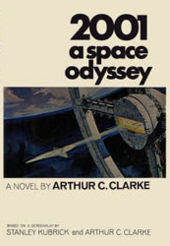
The book starts from an age long long ago (3 million years ago) when there were humanoid races in Africa. They managed to survive, only just, getting fruits and the like, and not knowing how to hunt. They had short life spans, and did not have either the feelings of attachment to each other, and would not have been able to do much either. They were at the mercy of wild beasts, with no instruments with which to defend themselves. And then arrives a rectangular black monolith that starts to delve into their minds, developing their minds. They learn how to develop tools from the natural materials at hand such as rocks and the sharp teeth of wild animals. And then they develop the thought of being able to even fight back against the wild animals that threaten them; and most important, get meat from the wild beasts roaming around them. Humanity gets kick-started, getting into a period of development that leads to us.
Cut to the present age. Humanity has started exploration on the moon, and there they discover something that astounds them. A sheer black monolith has been discovered underground in the moon, in a sector that the US controls, and the eminent Dr. Heywood Floyd is sent to the moon to do further investigations and help the scientists over there. He is told that they have discovered a magnetic disturbance in a site now called Tycho Magnetic Anomaly-One (TMA-1), and they discovered the monolith underground. It is clear that this is not a natural creation, and was actually created 3 million years ago, so this has to be aliens.
Soon, the lunar sunlight hits them, and the monolith, exposed to sunlight for the first time in 3 million years, sends a strong radio signal out that reaches the far extent of the solar system. Switch to the next episode in the book. A ship Discovery One carrying 5 astronauts and an advanced computer HAL 9000 is on its way to Saturn on an exploration mission. 3 of those astronauts are in a state of hibernation, and the remaining 2, Frank Poole and David Bowman, are the ones who are the ones who are supposed to be in charge of the ship (or more likely, be secondary advisors to HAL who can run the ship totally on its own).
The HAL 9000 is an advanced computer, but its designers had never thought about wondering about the impact of the orders it had been given to the intelligent brain. HAL had been given orders to conceal the real knowledge about its mission to both Poole and Bowman (to explore Japetus, the 3rd largest moon of Saturn, the destination of the radio signal from the monolith on the moon), and this was conflicting with its other orders to report all the information fully. This was causing a conflict, and in these strained times, when it felt threatened with termination, it actually decides to kill the astronauts.
So, first it kills Poole by reporting one of the critical AE35 units as malfunctioning twice, and then when Poole goes to investigate, killing him with his own space pod. Then when Bowman threatens it with shut-down, it opens the airlock of the spacecraft to the pressure of the vacuum. Eventually, Bowman gets to an emergency shelter, and then retakes control of the spacecraft by shutting down the circuits of the HAl 9000 computer. He also buries the 3 hibernating astronauts in space, and decides to complete the mission on his own control.
He reaches Japetus with a lot of help from mission control, and discovers a black monolith on the surface. While reporting all this to mission control, he decides to approach Japetus using his space pod, and when almost there, before the pod reaches the monolith, he sends out a final signal 'The thing's hollow — it goes on forever — and — oh my God! — it's full of stars!'
Bowman goes through an extra-ordinary journey, realizing that the monolith is a giant switching system, similar to a 'Grand Central Station' of the universe. He sees things that he never thought that he would see, while in a protective shield that saves him from the surrounding regions (including a very close red sun). As he finally sleeps, his mind and memories are drained from his body, becoming a new immortal entity that can travel through space, a Star Child. Bowman now returns to the Solar System and Earth, and is now a very powerful entity, but unsure of what to do - something that he will eventually figure out.
Posted by
Ashish Agarwal
at
5/18/2008 02:54:00 PM
0
comments
Labels: Classics, Computer, English, Epic, Fiction, Invention, Novel, Science, Science Fiction, Travel
The Rest of the Robots by Isaac Asimov
Isaac Asimov was one of the pioneers of the field of writing about robotics, and was most famous for his creation of the Three Laws of Robotics:
1. A robot may not injure a human being or, through inaction, allow a human being to come to harm.
2. A robot must obey orders given to it by human beings, except where such orders would conflict with the First Law.
3. A robot must protect its own existence as long as such protection does not conflict with the First or Second Law.
These seem simple enough, but as with laws for humans, there can be many interpretations and conflicts that can arise out of using these laws. 'The Rest of the Robots' is a set of 8 short stories that all deal with robots, and many of them also have references to these laws as well as situations arising out of problems with the use of these laws. I found the collection to be very readable and interesting, and considering that most of these stories are more than 50 years old, not dated in any way. We have not had the development of humanoid robotics to the extent that Asimov had written about, so many of these are stories that we will still need to worry about.
The collection was released in 1964, and hence you can consider the book to be a very old book indeed, and yet when I was browsing through some Asimov books on an online bookshop, I found it easily available, which means there is a regular demand for it. The book starts out with a foreword by Asimov in which he explains about how books used to be about robots, they were seen as being part of the Frankenstein complex, where man created robots, and robots would destroy man, and this happened again and again. Asimov chose to move away from this concept, and wrote stories with far more complexity and depth.
The book has 8 short stories:
1. Robot AL-76 goes astray: A story in which a robot bound for the moon somehow manages to get loose on earth, and has to try and figure out its surroundings, especially when it has been fed only information about the moon. It creates a great new machine, but then destroys it when ordered to in mistake. A comedy.
2. Victory international: About projecting the power of robots, especially those constructed with a great deal of care to make extra-strong so that they can impress the ferocious inhabitants of Jupiter.
3. First law: About an exception when the power of the First Law cannot suppress the maternal instincts of a robot, and the robot is willing to let a human die.
4. Let's get together: A political story about robots being used as terrorists. Showcases one of the biggest fears of humanoid terrorists.
5. Satisfaction guaranteed: One of the most complex stories of this volume. Deals with human emotions such as jealousy, envy and a feeling of low confidence, and how this interfaces with the First law.
6. Risk: About how the human mind can still be a much better instrument to deal with uncertainty and complexity rather than even the most complex positronic brain.
7. Lenny: About the maternal instinct in even the most seemingly hard-boiled scientist can come about when dealing with an under-developed robot.
8. Galley slave: A story which deals with the fear in a human about the advent of robotics and how this could totally destroy human creativity in a slow and gradual way.
The last 4 stories also had the character of Dr. Susan Calvin, whom Asimov used as a representative of the robopshycologist, the head in that area for US Robotics, and a pioneer in the development of robots.
Posted by
Ashish Agarwal
at
5/18/2008 01:20:00 PM
0
comments
Labels: Business, Classics, English, Feelings, Fiction, Invention, Novel, Robots, Science, Science Fiction, Short Story
Tuesday, May 13, 2008
Airframe by Michael Crichton
Airframe is an interesting novel by Michael Crichton. It starts out with a normal flight returning back to Denver from Hong Kong when suddenly the whole plane starts to go haywire. The plane starts rapidly going out of control, and everything inside moves very rapidly, with passengers getting bounced around. And the plane declares a emergency off the California coast, and makes a rapid landing. A pretty horrific event. This starts the whole novel.
A typical event like this, which results in injuries and deaths to passengers will get investigated to the last bit of detail; after all, if there is a problem inside the type of plane, it needs to be found out so that the same thing can be avoided on other planes with other airlines. Part of the people who get affected by such an accident are the plane manufacturers, Norton Aircraft. They have to quickly figure out what went wrong, both to avoid scaring other airlines and to satisfy other stakeholders such as the media, shareholders, etc.
The person central to this novel is Casey Singleton, a divorced single mother who is currently the Quality Assurance Representative on the Incident Review team (the team who actually does these sort of investigations) at Norton Aircraft. She will also be the press spokesperson, a high pressure job. Unfortunately, for the investigating team, there are some constraints;
- The flight crew has already left the country
- There is a probable deal with the Chinese airlines for 50 aircraft, so this incident needs to be investigated accurately within a very short time
- The union has heard rumours about a vital transfer of technology to China, and is beginning to get hostile
AS the investigations start, Casey soon discovers that not everything is as it seems to be, and she could very well be the scapegoat. She also has to balance being a single mother on top of everything else. She is also getting attacked by a mediaperson out to get some sensational stuff. DOes she manage to do a good job and uncover the truth ?
Saturday, February 2, 2008
Asimov's Nightfall
A classic science fiction novel, Nightfall was first published as a short story in the September 1941 issue of Astounding Science Fiction, written after some friendly persuasion by the editor of the magazine - John W. Campbell. The story was later adapted into a complete novel, and one that was acknowledged to be an incredible piece of science fiction (but it was not just science fiction, but a psychological look at a society when it suddenly encounters a very changed environment and raises questions about how humans respond to unknown stimulus). The influence and power of this story was such that it was declared in 1968 as the best science fiction short story ever written prior to the establishment of the Nebula Awards (the awards were established in 1965) by the Science Fiction Writers of America.
Nightfall has a pretty simple story. The story deals with human (like) society on an alien planet Lagash (Kalgash in the novel adaptation) that has a unique sky. It has a total of 6 suns all around it the stellar configuration (the various suns being Onos, Dovim, Trey, Patru, Tano, and Sitha). Because of these 6 suns, the planet is always in light and the inhabitants have not known darkness. They are so habituated to always having light that standing a time of darkness can be unnerving for most people. For example, a new amusement park ride that promises a time of total darkness has scared and traumatized many people.
The story has 3 main plots that all move to the same merger. There are the archaeologists who make the discovery that the ground strata of the planet seems to indicate that civilization builds up and then destroys itself, and that this has not happened once, but seems to keep on happening in a cycle. The researches are puzzled as to why such a thing keeps on happening, after all, most civilizations advance and maybe stagnate, but don't keep on going through a repetitive cycle of advance and decline.
Similarly, physicists discover that the there are irregularities in the orbit of Kalgash around its primary sun Onos. After more studies, the conclusions that they keep on heading towards is a horrifying one. The discovery is that the planet has a so far unknown satellite that causes the irregularities, and plotting the orbits of the planet, the satellite and the 6 suns lead to a conclusion that just cannot be true. After all, everybody knows that the planet has always had sunlight, so how can there be a time of many hours when the suns and the satellite reach a position where there is no light on the planet. Such a situation can cause mass hysteria and madness.
And then there is the political angle. There is a group known as the Apostles of the Flames, that calls itself as an ancient society; their belief (like a religious belief) is that civilization dies out with the appearance of darkness and then the stars that unleash fire. They are trying to gain more authority and political power.
These 3 combine together to reach a conclusion - every 2,049 years, the sole sun on one side of the planet is eclipsed for half a day, and this is a time when society (never having experience darkness) will go through madness and anarchy, with fire and chaos.
The rest of the novel is about this time coming closer, and then what happens when that time appears. This is a fascinating propounding of the state of the human mind, its irrationality in believing weird faiths and religious fervor when faced with a new thing.
Posted by
Ashish Agarwal
at
2/02/2008 08:02:00 PM
0
comments
Labels: Novel, Science, Science Fiction
Sunday, January 6, 2008
A Short History of Nearly Everything - Bill Bryson (2003)
What happens when a writer, known so far for travel books and about history, and who tickles the funny bones in your body, decides to write about science. Writing books about science and making them interesting have broken many authors, so when I first picked up this book, I was a bit worried. Well, when I finished the book, I let out a sigh of relief. While imparting a fair amount of education about science (although not about explaining the complicated algebra and geometry), the book does convey a great deal and did so in a very entertaining way.
Of course, if you are a scientist, you would take away almost nothing from this book, since it hardly claims to propound a new version of the string theory; one thing anyone can learn from such a book is how to write books like this that will explain a large number of concepts while keeping the overall subject light; and at the same time, making things more life-like by explaining details about the scientists that hardly ever makes it out.
Typically when you read about a scientist, you will learn about the great inventions that the scientist did, and how great it was and how beneficial it was. Typically such inventors are treated in a very god-like manner, and way above reality. Bill Bryson explains a lot more about such scientists, including their failing and weaknesses, and make them seem more life-like.
You will get to feel about what the situation and surrounding environment was like for such great scientists such as Charles Darwin, Isaac Newton, Albert Einstein, and many others. And this is exactly the reason why this massive 500 page plus book was written. Like all of us, Bill Bryson learnt all the facts about science, but again like us, in a very dull manner. He wanted to understand the reasons as to why something was discovered, the motivation of the scientists, the environment around them, and so on; all these help in understanding the development of science in a much more understandable way. This works great - you learn as to how Newton was also an egoist and also responsible for sending many counterfeiters to the gallows in an official role; or how the great Cavendish was such a recluse that he would even communicate with his housekeeper through letters.
In addition to the part about scientists, you also learn about sizes in this universe, from the size of our planet to the size of galaxies, about the development of Homo Sapiens (us) and what separates us from our biological cousins (the chimpanzees) to whom we are more than 98% genetically similar. You learn a lot about such varied subjects such as fields of cosmology, astronomy, paleontology, geology, chemistry, physics and so on.
For writing this book, Bryson spent over 3 years, talking to various scientists and understanding things from them; as a result of his not being a scientist himself, there have been errors that have been pointed out in the book; but overall, I stick to my thought that this was a wonderful book that tried to explain how scientists and science learn about everything (and something that you never read about).
Posted by
Ashish Agarwal
at
1/06/2008 11:30:00 PM
0
comments
Labels: History, Invention, Life, Non-Fiction, Science
Made in America - Bill Bryson (1996)
For those of you who have not read books by Bill Bryson before, be prepared for a blast. These books are non-fiction, but are incredibly funny. There has been many a time when I have had to go back and read a section that I just read since it made me laugh (and I wanted to laugh again). Some of the other great books of Bill Bryson that you should read are a 'A Lost continent', 'A walk in the woods', 'A short history of nearly everything', 'Down Under', and so on (you get the picture - I have yet to read a Bill Bryson book that did not appeal).
This book is about the development of English language down the ages, so you will find a lot of detail about how words came to be added to the English used in the United States, such as derived from the American Indians who were living there when the settlers first went in, from various languages (or rather from the immigrants of various countries such Germany, French, Irish, British, and so on,) and from whom many words of the language came to be derived, though many times these were twisted and turned in a way that the original speaker would not have realized.
But is this just a scholarly exposition of the development of the English language used in the United States ? That would be downright boring. To everyone's relief, such is not the case. The book delves into the history of the United States and presents a great many facts while reliving the story, at the same time, debunking many myths that we have. The book is a great read for anyone who wants to read about the history of the United states through its culture, not through politics or war. From the starting, the book is a wonder of facts and learning:
- Giving a lot more detail about the original settlers and whether there were people before them
- About the way that the original settlers almost got wiped out, but survived due to the help of the native Indians nearby
- About the nature of the apparently frigid puritans and the easy prevalence of sex before marriage as a way to measure compatibility and how many marriage were formalized after a baby had been conceived
- A great many myths around the American revolution including heroic words and actions ascribed to people who apparently did no such thing
- The womanizing nature of Benjamin Franklin
- The great debates and concerns around having the different time zones and even more so, the concept of daylight savings time
- A lot of description of the many inventions and the different nature of the investors (their human traits as compared to the noble myths around them)
and so on
Too many to tell, it is better read from the book which is a very enthralling reading.
Posted by
Ashish Agarwal
at
1/06/2008 11:25:00 PM
0
comments
Labels: Adventure, Country, Guide, History, Humour, Invention, Non-Fiction, Science