Showing posts with label Epic. Show all posts

Friday, October 1, 2010

The Word (published in 1972) - written by Irving Wallace

Irving Wallace was born in Chicago, to Jewish parents,Bessie and Alexander Wallace Who had emigrated from Russia. He completed his studies in California and started out as a journalist at a tender age of 15. He studied creative writing at the Williams Institute in Berkley and from the mid-30s he worked as a free-lance correspondent. In 1941 he married Sylvia Kahn; they had two children. Irving Wallace served in the air force during world war two and later collaborated in several movies as a writer. His first book “sins of Peter Fleming did not attract much attention. But his second book influenced by the Kinsey report was a best seller. He has been a prolific churner of best sellers and his books have been adapted as major movies. He died on June 29, 1990.
The Word published in 1972 works on the premise that Religion is indeed the opium of the masses. A multimillionaire undertakes the publication of a newly discovered Gospel of James. According to this Gospel, Jesus does not die on the cross but is buried alive. All his followers have dispersed and only James remain at his side. Jesus talks to him and prays for everybody and also for his adoptive father, Joseph. Then a fully recovered Jesus goes abroad to deliver his teachings. According to the Gospel of James, the death and resurrection of Jesus occurs in Rome 20 years after the crucifixion.


Steven Randall, an alcoholic, atheist lawyer is hired by George Wheeler to publish the new testament. He is facing opposition from skeptics, the prominent one being Maertin de Vroome. Steven's personal life is in shambles, as his wife being separated from him, his daughter caught plying drugs and expelled from school and he being the biggest disappointment for his clergyman father. Steven travels to Europe with his lover Darlene and meet eh movers and shakers who are involved in the publication of the new testament. The most important person he meets is Prof. Augusto Monti who is confined to an asylum and talks in riddles. Steven is unable get coherent answer's from him but gets two codes, that of a fish and a harpoon. As Steven goes deciphering this he meets Monti's daughter, the beautiful Angela who falls for him. Steven and Angela hit it off and become lovers.
But the biggest shock awaits Steven as he encounters Maertin de Vroome who insinuates that the Gospel is a work of forgery by a petty French thief Lebrun. Although initially skeptical Steven meets Lebrun who confirms the act of forgery. Steven rushes to stop the publication of the book and is thwarted by the powerful religious lobby. A disillusioned Steven retreats to more alcohol and obscurity. As Steven battles with his conscious, he is not able to do anything. He even finds his father taken in by the new Gospel. As the book comes to a close we find the moral and mental dilemma of Steven lighting up a new path and consciousness. This book by Irving Wallace may show shades of Dan Brown, but the message is completely different. You need to feel the faith and even a forged document can elicit passion and belief in a person's life changing it forever. A must read for all Wallace's fans.

The Word (published in 1972) - written by Irving Wallace

Monday, June 28, 2010

Guns of Navarone (Published in 1957) authored by Alistair MacLean, a classic set in the Second World War

Alistair MacLean is a Scottish writer who specialized in writing thrillers and crime stories. He was third son of a Scottish minister and joined the Royal Navy during the world war two. He was a senior torpedo operator at the height of his career. He was in the thick of the war theater during the world war and saw action on many fronts especially the arctic north. After retiring he started penning his novels based on the war he saw and many of them became best sellers. Maclean never looked back as a writer until his death in 1987.
MacLean's characters are men who fight against all odds. They are ordinary men who are thrown in to situations which are physically and emotionally demanding. Many of them never think about surviving, and their only instinct is to fight the odds. Some succeed, some redeem themselves and some sacrifice. But in the end all are heroes. This story is based on the battle of Leros during world war two. This is one of the most successful of MacLean's books which was made in to a successful motion picture.


The battle takes place in the year 1943 during the the world war two (based on the battle of Leros) where more than 2000 English troops are holed up. Their evacuation is possible only if the route through the island of Navarone is opened up, but this is not possible till the route is made safe from the huge guns overlooking the route which threaten any ship trying to pass through. It is needed to remove these guns, something which seems incredible, and this impossible task is put to a crack team is put together to neutralize the guns of Navarone.
The team is led by Captain Keith Mallory, a mountaineer from New Zealand who is also a commando, Andrea Stavros, a Greek colonel, Corporal Dusty Miller (an American explosives expert), Petty Officer Casey Brown (a Royal Navy personnel, from the Special Boat Service), and many others. They ultimately set sail to Navarone disguised as Greek fisherman.
Their boat has to fight the ever present enemy - the water and the sea, but eventually they reach the foot of the cliff and have to climb the sheer cliff in a storm, where the experience of Mallory proves invaluable.
They are one step ahead of the Germans, but just, and they have a timeframe whereby they have to blow up the guns to give the trapped men a chance through a relief convoy; in addition, like you would expect from such a book, one of the people supporting them is also betraying them. How do they manage to get into the fortress, and destroy the guns ?

Guns of Navarone (Published in 1957) authored by Alistair MacLean, a classic set in the Second World War

Saturday, June 26, 2010

HMS Ulysses (published in 1955) - written by Alistair Maclean and about the struggle of a doomed ship during the war

Alistair MacLean is a Scottish writer who specialized in writing thrillers and crime stories. He was third son of a Scottish minister and joined the Royal Navy during the world war two. He was a senior torpedo operator at the height of his career. He was in the thick of the war theater during the world war and saw action on many fronts especially the arctic north. After retiring he started penning his novels based on the war he saw and many of them became best sellers. Maclean never looked back as a writer until his death in 1987.
Because of his war experiences, his novels are also high on the action content. The emotional and the romantic angle is not very much touched upon by Maclean. His characters are highly cynical men who are always part of the high octane action and push themselves against all odds with out any thought for their safety. The elements also play a very important in MacLean's writings. Most of the time his men are pitted against harsh unforgiving surroundings which brings out the innate nature hidden inside, be it a devil or a hero.
HMS Ulysses is Alistair MacLean's first novel and is largely drawn upon his war experiences. The true story about the ill-fated convoy PQ-17 provided the basis for this story. It tells us the story of ordinary men who fight against seemingly unsurmountable odds just to prove their loyalty. HMS Ulysses is Captained by Richard Vallery, who commands unflinching loyalty from his men.


The story begins with Ulysses at Anchor in Scapa Flow after a grueling mission as an escort ship in the arctic north. The men are exhausted and tired battling the harshest of climates coupled with low food rations. They are emotionally exhausted because of the battle of nerves against the U-boats, enemy aircraft and ships. These men learn upon weighing the anchor that the higher authorities are planning to send them back in to battle and are ready to put them through the same grind with out any concerns for their well being. A mini mutiny spreads across the ship and only their loyalty towards Richard Vallery prevents them from deserting.
Now a much soothed crew find that the trust in their abilities is eroded and orders are very clear, - escort a convoy through the battle field of Murmansk and on return will be rewarded with a draft to the Mediterranean. HMS Ulysses is to use to bait German Destroyer Tirpitz and help her destruction. The Captain and the crew accepts the terms for the sake of redemption.
But a fierce storm is raging in the Arctic, coupled with death stalking Ulysses in the form of U-boats and fighter planes above. Men have to fight against bone chilling cold and the waters toss the Ulysses with no mercy with the specter of tuberculosis among them. In the last pages Alistair Maclean graphically describes the hopelessness of the expendable men battling everything stacked up against them and sacrificing their lives for honor. Glory is for them for ever because the mind numbing hopelessness brings the men to give the battle everything they have, not to survive but to sacrifice and win.

HMS Ulysses (published in 1955) - first book written by Alistair Maclean and about the struggle of a doomed ship during the war

Saturday, April 10, 2010

Murder on the Orient Express (1934) - A murder mystery starring Hercule Poirot - a complex mystery

By the time that this book was published (in 1934), Hercule Poirot had a big fan base and people would wait for a new novel to be released by Agatha Christie. The book is extremely famous, and has also been converted into a movie. The base plot of the book is seemingly based on the Lindberg baby kidnapping where the baby son of the famous aviator Charles Lindberg was kidnapped. Tragically, the child was murdered, and this was a very famous case (since Lindberg was extremely famous after doing a solo flight across the Atlantic). And the book has a similar case, where the person who was murdered was revealed to be behind a similar crime, something that gets revealed during the course of the investigation of the murder. The ending is a bit surprising for those who have read many of the other Hercule Poirot novels (and just for that, in this review, I will not reveal the ending - so if you have not read the book, try and get it).
Hercule Poriot is returning from Syria in the Orient Express in Istanbul, and has had to take help from a friend who is a director on the train company Compagnie Internationale des Wagons-Lits; he gets a berth when another traveler fails to show up.


And like many other mysteries, Poirot just happens to be on the scene when a murder happens (something which scares the perpetrators of the crime, since in the normal course of things, this would not have been a crime that would have been easily solved). In the course of a night near Belgrade, Poirot seems to hear a sound outside his door more than once, and does not encounter anybody. Further, a lady Mrs. Hubbard seems to believe that somebody was in her apartment. However, nobody is to be found.
The next morning, they find one of the passengers, Mr. Ratchett, to have died, rather been murdered. He was killed by many stab wounds, some from left handers, some from right handers, and some much deeper than the others. The train is stuck in a snow-storm, so it would seem that the murdered is still on the train. Poirot is the only one who can investigate, and he starts his investigation. He finds a number of clues, but many of them point in different directions. And then he discovers the past of Mr. Ratchett, who was actually a fugitive from the US called Cassetti. And he was behind the kidnap and murder of a young heiress, Daisy Armstrong, and had then fled from the country. Her parents died from the shock (her mother died from the shock, and her father killed himself).
And as he investigates, he realizes that other passengers on the train all had connections to the Armstrong family in the past, and thus any of them could have a motive, so who was the actual killer ?

Murder on the Orient Express (1934) - A murder mystery starring Hercule Poirot - a complex mystery

Sunday, December 20, 2009

Dombey and Sons - by Charles Dickens (1848)

Charles Dickens is one of the most famous authors from the Victorian era, who wrote about the lives of the various sections of society, including the most oppressed, based on his own personal experiences as well. He wrote extensively on social reform, and some of his books such as 'Great Expectations', 'A tale of 2 cities', 'Oliver Twist' are all time favorites, and used in schools to teach students about English literature.
Dickens wrote a large number of books, with Dombey and Sons being a book that was published in monthly serial form, published between October 1846 and April 1848 (like many of his other books - the custom was to publish in a magazine monthly, and leave readers anticipating the next version). "Dombey and Sons" is the short form, the complete name of the book is "Dealings with the Firm of Dombey and Son: Wholesale, Retail and for Exportation". Dickens was by nature stuck in London, by this time, he had already become successful, and used to travel a lot, and this book was written for a fair amount of time in Lausanne, Switzerland. But he also traveled a fair amount during this time, and he was also writing another book called "The Battle of Life".


The story is about the life of a wealthy shipping merchant called Paul Dombey, who wants a son as a heir. He already has a daughter called Florence, whom he neglects; finally his wife gives birth to a son called Paul, but she dies in childbirth, and Paul remains sick throughout his very short life, dying when he is only six years old. There is no change in the attitude of Dombey towards his daughter, and he continues to neglect her even though she pines for the love from her father.
Things keep on moving, with Florence getting friendly to a young man called Walter Grey; however Water is sent off to the Barbados by the firm's manager called James Carker, since Carker believes that Walter can become a rival to him. Walter is soon presumed lost in a ship-wreck; Dombey also marries a widow called Edith Granger, but she really does not love him, and soon runs off with James Carker.
Like most other Dickens novel, the book runs through stages where some things go well such as the finding that Walter was alive, and his return; while Dombey realizes that Carker had caused the firm to go bankrupt. The book runs through things fast, with Walter marrying Florence, and they taking care of Dombey, and Dombey realizing the love for his daughter and his grandchildren.

Dombey and Sons - by Charles Dickens (1848)

Monday, February 2, 2009

Mansfield Park by Jane Austen (1812)

By the time Manfield Park was written, Jane Austen had already released 2 of her earlier novels (Sense and Sensibility and Pride and Prejudice), and these were enough to make her famous. On the other hand, Mansfield Park was far more controversial. The principal character of Fanny Price has been acknowledged to be complex, a person of a good conscience. At the same time, the novel really does not reveal too much about her, since you don't really get to hear too much from her in the novel. Unlike's Jane Austen's characters from her earlier books, Fanny is far more straight in her thoughts and beliefs, and is not seen to be making any mistake. Jane Austen further seeks to strengthen the character of her heroine by making her childhood poverty be the reason for her strength, a point that is not likely to be something that modern audiences can understand.

Mansfield Park by Jane Austen (1812)

Mansfield Park is the name of a house owned by the wealthy Sir Thomas Bertram. He is married to Fanny's aunt (Fanny's mother married a poor solider, and hence their life has always been distant from the rich world of Sir Thomas). However, Fanny has been sent to her aunt's house to take care of her aunt, but because of her poverty, 3 of her cousins, Tom, Maria and Julia, ignore her and do not consider her to be of the same level. It is only the second son, Edmund, who treats Fanny kindly; as a result, Fanny has always looked at Edmund with devotion, which turns to love as she grows (the novel depicts her in a majority of the story to be at age 18-19).
Sir Thomas is strict, and this seems to have a bearing on the behaviour of his 3 children, Tom, Maria and Julia, who all have their own weaknesses, whether that be Tom's weakness for gambling, or the vain and arrogant nature possessed by Maria or Julia. Soon, Sir Thomas leaves for 2 years to tend to his estates in Antigua, and then the entire drama starts soon after, with the arrival of Henry Crawford and his sister Mary. Henry charms both Maria and Julia (specially Maria), and to Fanny's distress, Mary and Edmund start getting closer (although Edmund is not sure about Mary's true nature). However, in the midst of rehearsing for a play, Sir Thomas returns, and is not happy to see the ongoing rehearsal, effectively ending all thoughts of having a play. Henry and Mary leave for some time.
Henry, after returning, wants to amuse himself by charming Fanny, but finds himself falling in love with her instead. When he proposes marriage, and for a poor girl such as Fanny, this is a very good proposal, she already knows about his affairs with her cousins, and she declines. The entire family gets shocked, and she leaves Mansfield Park for some time. Soon after, there is another scandal, where Maria (who had married the rich but boring Mr. Rushworth) has an affair with Henry in London, leading to a divorce from her husband. At around the same time, Tom also falls ill, and Fanny heads back to Mansfield Park to take care of Tom. Edmund also realizes that Mary's true nature is not acceptable to him, and he actually loves Fanny. Eventually, Edmund marries Fanny.

Monday, September 8, 2008

A tale of 2 cities by Charles Dickens

One of the most brutal revolutions in Europe in recent times has been the French Revolution; it had many phases and can be taken to mean the period between 1789 and 1799, when the army finally took over in the form of its leader, Napoleon Bonaparte. In the interim period, there were many struggles, many twists and turns. A new instrument of murder, the guillotine, was the main execution tool. People condemned to death for anti-revolution fervor, for their thoughts, and because getting them condemned to death removed them from the scene, all would be brought to the public squares where they would be executed with the guillotine.
'A tale of 2 cities' was published in 1859, and is set during the time period of the French Revolution. It shows the sheer terror of those times, where you could be condemned to death for even sympathizing with the fate of an earlier executed 'enemy' of the revolution, where a person could be condemned based on the written statement of a person (even if the person wants to take the statement back). The terror of the French Revolution evolved during a complex stage in which the excesses of the nobility and the church had crushed the poorer part of the population (Wikipedia), and this was almost pay-back time.

A tale of 2 cities by Charles Dickens

The book led to a very remembered opening statement, starting with these incredible words, "It was the best of times, it was the worst of times, it was the age of wisdom, it was the age of foolishness". The book covers the conflicting story of many people, including arrogant aristocrats who were condemned, humble and good aristocrats who were also condemned, people taking revenge using the medium of the revolution, and how the revolution eventually also condemns those who were its proponents earlier. The book has been used as the base for a number of movies over the years, and was itself based on the book 'The French Revolution: A History' by Thomas Carlyle.
The novel covers the story of the following main characters:
- Dr Alexandre Manette: A prisoner in the Bastille for 18 years, and the father of the lady who is one of the main characters
- Lucie Manette: Young lady loved by both Charles Darnay and Sydney Carton, and also the daughter of Dr. Manette
- Charles Darnay: A young, and good-natured French nobel. He never liked the cruelty of his family towards the peasantry and abandons the family name (Evrémonde), and fled to England after assuming his mother's maiden name
- Sydney Carton: A complex, but depressed English barrister. Loves Lucie, and promises her that he will do whatever he can for her and her family. Eventually does so in the end with a supreme act of self-sacrifice.
- Monsieur Ernest Defarge: Took care of Dr. Manette, also a closet revolutionary
- Madame Therese Defarge: A dark-natured closet revolutionary and wife of Ernest. She is also bent of taking revenge for the extermination of her family at the hands of Darnay's uncle

Thursday, July 24, 2008

Kane and Abel by Jeffrey Archer

For those of you who have not read this novel, but the name sounds somewhat familiar, worry not. You are indeed correct, with the name being similar to the biblical 'Cain and Abel'. The novel was released in 1980, with was an international bestseller. It remains on the popular list, being among the more famous, if not the most famous, book of Jeffrey Archer. It has been made into a 1985 television mini-series as well. The book is essentially a life story of 2 men, born into 2 entirely different societies and circumstances, but sharing the same date of birth, April 18, 1906. This book is the story of William Lowell Kane, and Wladek Koskiewicz (later to be called Abel Rosnovski), and truth be told, is a great book.

Kane and Abel by Jeffrey Archer

These are 2 men with an entirely different start in life, with one thing in common; both are extremely confident and self-starters. They have built up whatever they currently own in life, and are willing to take a fight all the way to the end.
Kane is born in a rich family, but loses his wealth and inheritance after a series of misfortunes. His father dies in the Titanic disaster, and his mother marries a man who does nothing but squander his wealth and waste it away. Eventually, after his mother dies in a miscarriage, Kane throws his step-father out.
Abel, on the other hand, lives a life of poverty. He is born in a forest, and only gains some hope of a better life due to his intelligence; the local Baron recognizes his intelligence and seeking to get a good companion for his son, adopts Abel. However, soon after, with the First World War breaking out, the Russian Army kills the Baron and his son, rapes Abel's sister, and takes Abel to Siberia (However, Abel also discovers that the Baron was actually his father, since both of them have only one nipple each). Abel manages to escape from Siberia, and after almost getting his hand amputated in Turkey for stealing, he manages to reach the US.
And this is where the battle between the 2 starts to germinate. After Abel starts to rise by dint of ability, his benefactor suffers because Kane's bank refuses to lend funds during the depression, and actually commits suicide. Blaming Kane for this, Abel has two ambitions, how to become a successful and rich man, and how to defeat Kane. He has one option, if he can get enough shares of Kane's bank, he can get Kane kicked off the board (he does not know that Kane was the one who had actually helped him in the past and Kane cannot tell him also).
This rivalry takes a strange turn when the children of both of them meet, fall in love, and marry over the massive objections of both of them. What happens next ? Do these 2 bitter enemies forgive their children and each other, and reconcile with their grandchild ? Read the whole novel, it is a great work of fiction.

Sunday, June 15, 2008

Great Expectations by Charles Dickens

Great Expectations is a great book, an all-time classic. The book is set in a period from 1812 to the winter of 1840, in the England of that time. The book was actually a series in the 'All the Year Round'. Charles Dickens has always been considered a writer who can write about a whole gamut of human relations, but there has always been a strong element of pathos, of pain, of despair, and totally shies away from portraying life as rosy. Charles Dickens has also been known to write elements from the story of his life in his novels, weaving his life and experiences through the medium of the story. When he wrote this magnificent novel in the form of a series, he had to ensure that each episode was gripping enough that people would wait for the next part of the series to arrive.

Great Expectations by Charles Dickens

The book is divided into 3 stages of the life of the orphan Pip, his young life when she stays with his sister and her husband. He is comfortable with his life, and has no great expectations from it, until the time he meets a very bitter elderly woman Mrs. Havisham (who was jilted on marriage and becomes very bitter towards men) and her adopted daughter Estella. Mrs. Havisham hates men, and has accordingly inculcated a strong feeling of coldness in Estella, something which is to stay with her in life. Pip continues his life, then becomes an apprentice to Joe (his sister's husband). However, his life is turned upside down when he is informed that he has been bequeathed a large sum of money by an unknown benefactor. Pip's expectations are now increasing, and his earlier contact with Mrs. Havisham had made him want to be a gentleman when he grows up, and this wealth will help him a lot.
In the second stage, Pip is now living the fine life in London. He is rich, and adopts the customs of the rich and the cultured, very different from his earlier life. In this life, he pursues Estella, who is now a very beautiful, but very cold person (not caring much about his feelings); he has a rival in the form of Bentley Drummle, whom Pip despises and cannot understand why Estella sees him. Pip has assumed that his provider is in fact Mrs. Havisham, and this also creates a lot of jealousy in her other relatives who are looking forward to her property. However, this Pip has now developed a class attitude, and is ashamed of the lower status of Joe, and is embarrassed when Joe visits. And then he learns that his benefactor is in fact a former convict (who Pip had helped many years back), Abel Magwitch.
In the third stage, this is when things start going downhill. Estella does not acknowledge his advances, and Pip is repulsed by the knowledge that his benefactor was a former convict, and he starts to acknowledge that the allowances will now stop coming. He plans a way to get Magwitch to leave the country, since if he is caught, he will be sentenced to a harsh term. He creates a great plan, but the plan eventually fails and Magwitch is caught and sent to jail, where he dies (but not before Pip visits him and has already warmed to him). In the end, all of Pip's Great Expectations come to naught, and he learns to live a life without such high expectations.

Tuesday, May 27, 2008

War and Peace (by Leo Tolstoy)

'War and Peace' has been called as the best novel ever written, and while there would be other favorite novels and people might consider other novels as the greatest, there is no getting around the fact that this is a great novel. War and Peace is taught in many English literature courses as an alltime great book by a great author (his other work, 'Anna Karenina' was also very famous).
The story is set around the 1812 French-Russian war where the French emperor, Napolean had invaded Russia. This was eventually a great disaster for the French, since they first managed to take Moscow (which had been abandoned by the Russians as a part of this war), but this did not do them too much good. The Russian winter had already set in, the army had to eventually return back, and they were harassed by the Cossack attacks. They lost a majority of their force in this return, and at the same time, left most of the wooden structures of Moscow burning.

War and Peace by Leo Tolstoy

The novel was published through a period from 1865 to 1869 in the 'Russkii Vestnik', and went through 2 complete different forms. Tolstoy was not happy with the first published draft, and totally rewrote the novel to get another version, that was the final published version. This original version was also published again in the last 2 decades and is now available in many languages after translation. The writing of the book in its original also reflects some of the cultural norms of the society of that time - while most of the book was in Russian, there are many dialogues that were written in French since this was the language of the French aristocracy. There is apparently a small patriotic subtext in the book as well as regards language - French is used more to denote insincerity while Russian is increasingly used to show the more honest and better part.
The book takes characters from 3 main Russian families (The Rostovs, the Bolkonskys, and the Bezukovs, along with some more associated characters), including those who are part of the nobility and those on the edge of financial ruin, and takes the movements in their life, centered around the oncoming conflict with France, and moving onto the changes that happen due to this conflict, and the aftermath. An imposing historical figure such as Napoleon is a side part of this story, it is the impressive flesh and blood tale of these Russian characters, intersection with a description of the Russian society at that time that makes this a very impressive work of fiction.
The story presents some major characters such as Pierre Bezukhov (the main character, very honest, but not worldly wise - supposed to be a reflection of Tolstoy himeself), Prince Andrei Nikolayevich Bolkonsky (brave, a soldier looking forward to the war), Natasha Rostova (starting out as a young girl, she goes through many trials and tribulations, and eventually gets married to Pierre), Nikolai Rostov (another soldier, also responsible for trying to keep his family from financial ruin), Sonya Rostova (a poor cousin, she was engaged to Nikolai, but eventually releases him so that he can marry the rich Princess Maria), and many other such characters.

David Copperfield (1850)

David Copperfield is probably the book that is the most autobiographical of Charles Dickens novels, borrowing many sections from his life. Charles Dickens (1812-1870) lived in poverty during his childhood, being one of 8 children. He had little formal education, and yet grew out of his circumstances to become one of the most famous writers of all times. Many of his novels are prescribed reading in English literature courses in schools and colleges. Most of his books are based on human emotions, and contain a fair amount of poverty, human emotions, and so on. They present a vivid picture of human society.

David Copperfield

The novel was published in 1850, and like his other novels, appeared in serial form in monthly installments. Dickens also reckoned this book to be his favorite novel. The novel was written in the first person, with David Copperfield being the narrator of the novel. The book has one clear message: The disciplining of the life (emotional and moral) of the hero, presenting a number of characters who are either disciplined, and others who are not disciplined. The book portrays the various characters in terms of the discipline in their life, including Agnes Wickfield, Mr. Peggotty, Uriah Heep, James Steerforth, Betsy Trotwood, Dora Spenlow, etc. Many of these characters have become very famous.
The book is about the life of David Copperfield, who loses his father six months before he his born, and he gets a new stepfather (Mr Edward Murdstone) when David is around 7 years. David cannot stand him or his sister, Jane and gets sent to a boarding school soon after biting his stepfather. When David returns home in a break, he finds that his mother is going to have a baby. However, when his mother and her baby die, David has to return to the home, and gets sent to a factory in London, where David has a doleful and poor experience. Soon, the factory owner goes bankrupt, and David manages to make his way to Dover to be with his aunt, and finally free of his stepfather.
He comes across many more character as he moves to adulthood, some of them good, kind and caring; others were selfish. Eventually, they get some sort of desserts for their acts. David himself finally finds happiness with his second wife, Agnes.

Sunday, May 18, 2008

2001: A Space Odyssey by Arthur C Clarke

If there are 2 things that Arthur C Clarke will be most famous for, my guess would be for his visionary work, including the concept of a geo-stationary satellite (most famously used to position communications satellites) and for his creation of the best seller 2001: A space Odyssey and its sequels (2010, 2061, and 3001). These were created for and along with an incredible movie of the same name by Stanley Kubrick. Together, this book, and the novel both captured the fascination with space (and its dangers), along with a fear of what an advanced computer (H.A.L) can do (somewhat similar to the fear of sharks that got positively entrenched with the movie Jaws).
Both the book and the screenplay for the movie went hand in hand, and were based on the short story 'The Sentinel' written by Arthur C Clarke in 1950. The novel was an important milestone in the history of science fiction, combining elements of man's historical development, delves into development of space travel and the problems of differential gravity, aliens and the thought that there is a master race that kick-started human development, and then how mankind may not have worked out all the issues related to intelligent computers.

2001 A Space Odyssey by Arthur C Clarke

The book starts from an age long long ago (3 million years ago) when there were humanoid races in Africa. They managed to survive, only just, getting fruits and the like, and not knowing how to hunt. They had short life spans, and did not have either the feelings of attachment to each other, and would not have been able to do much either. They were at the mercy of wild beasts, with no instruments with which to defend themselves. And then arrives a rectangular black monolith that starts to delve into their minds, developing their minds. They learn how to develop tools from the natural materials at hand such as rocks and the sharp teeth of wild animals. And then they develop the thought of being able to even fight back against the wild animals that threaten them; and most important, get meat from the wild beasts roaming around them. Humanity gets kick-started, getting into a period of development that leads to us.
Cut to the present age. Humanity has started exploration on the moon, and there they discover something that astounds them. A sheer black monolith has been discovered underground in the moon, in a sector that the US controls, and the eminent Dr. Heywood Floyd is sent to the moon to do further investigations and help the scientists over there. He is told that they have discovered a magnetic disturbance in a site now called Tycho Magnetic Anomaly-One (TMA-1), and they discovered the monolith underground. It is clear that this is not a natural creation, and was actually created 3 million years ago, so this has to be aliens.
Soon, the lunar sunlight hits them, and the monolith, exposed to sunlight for the first time in 3 million years, sends a strong radio signal out that reaches the far extent of the solar system. Switch to the next episode in the book. A ship Discovery One carrying 5 astronauts and an advanced computer HAL 9000 is on its way to Saturn on an exploration mission. 3 of those astronauts are in a state of hibernation, and the remaining 2, Frank Poole and David Bowman, are the ones who are the ones who are supposed to be in charge of the ship (or more likely, be secondary advisors to HAL who can run the ship totally on its own).
The HAL 9000 is an advanced computer, but its designers had never thought about wondering about the impact of the orders it had been given to the intelligent brain. HAL had been given orders to conceal the real knowledge about its mission to both Poole and Bowman (to explore Japetus, the 3rd largest moon of Saturn, the destination of the radio signal from the monolith on the moon), and this was conflicting with its other orders to report all the information fully. This was causing a conflict, and in these strained times, when it felt threatened with termination, it actually decides to kill the astronauts.
So, first it kills Poole by reporting one of the critical AE35 units as malfunctioning twice, and then when Poole goes to investigate, killing him with his own space pod. Then when Bowman threatens it with shut-down, it opens the airlock of the spacecraft to the pressure of the vacuum. Eventually, Bowman gets to an emergency shelter, and then retakes control of the spacecraft by shutting down the circuits of the HAl 9000 computer. He also buries the 3 hibernating astronauts in space, and decides to complete the mission on his own control.
He reaches Japetus with a lot of help from mission control, and discovers a black monolith on the surface. While reporting all this to mission control, he decides to approach Japetus using his space pod, and when almost there, before the pod reaches the monolith, he sends out a final signal 'The thing's hollow — it goes on forever — and — oh my God! — it's full of stars!'
Bowman goes through an extra-ordinary journey, realizing that the monolith is a giant switching system, similar to a 'Grand Central Station' of the universe. He sees things that he never thought that he would see, while in a protective shield that saves him from the surrounding regions (including a very close red sun). As he finally sleeps, his mind and memories are drained from his body, becoming a new immortal entity that can travel through space, a Star Child. Bowman now returns to the Solar System and Earth, and is now a very powerful entity, but unsure of what to do - something that he will eventually figure out.

Monday, February 11, 2008

O Jerusalem - Larry Collins & Dominique Lapierre

Most people would have heard of the Israeli-Palestinian conflict, at the same time, a vast majority of the same people would have little or no knowledge of the background of the conflict; or of the history of the region of the region at the time of the founding of Israel in 1948. The conflict has split people so widely that it is hard to find people who do not have a bias on the subject. The same is true of people who have written on the topic. In the midst of all this, to find a book that details the history of the region in a relatively unbiased way is difficult. This book is a very close approximation of the detailing of the history of that region that seeks to present history without too much bias.

O Jerusalem by Dominique Lapierre and Larry Collins
Jerusalem is without doubt the most disputed territory in the world, and still at the center of Israeli-Palestinian conflict. Even now, most Islam inspired terrorists consider the cause of Jerusalem to be central to the conflict. Jerusalem is the holiest of holies for Jews, the site of the destructed Second Temple (and the remaining Western Wall from that temple); in addition, the same complex contains the Dome of the Rock and the Al-Aqsa mosque, the third holiest site for Muslims (said to house the rock from which the prophet Mohammed ascended to heaven on his horse along with the archangel Gabriel); to round off the religious significances, Jerusalem also contains the Church of the Holy Sepulchre, built on the grounds that are venerated as the place where Jesus was said to have been crucified and buried. It is not hard to imagine why the city of Jerusalem has always been a much sought over city.
To write a book about such a place is not easy. Such a book will be reviewed very critically, examined for bias, and every historical fact mentioned checked. To ensure that they did a good job, the authors, Dominique Lapierre and Larry Collins, spent 5 years of research, checking historical documents and records. The overall aim was to write a book that aims to provide details of the facts and circumstances surrounding the creation of the state of Israel - to that extent, the book presents details of all the chief players of that time - the Arabs, the British who had the mandate of the region of Palestine, and the various players on the Jewish side (simple soldiers, religious leaders, the leaders (David Ben-Gurion, Golda Meir), as well as the various organizations on the Jewish side (Hagannah, Irgun, Stern)).
The book itself starts from the time when the United Nations (in 1947) voted to partition the British mandate of Palestine into 2 parts - one to be the state of the Jews called Israel, and the other to be a Palestine state. However, both sides knew that this was not the end, there would be a war; and both sides prepared for war. So, for example, Israel sent its men abroad to buy arms and needed to setup an army and air force that could hold up its own against the might of its Arab neighbors. Similarly, the Arabs went to buy arms, and also worked at ensuring that all the constituents of the Arab side worked together. As the end of the mandate came closer, war became more imminent. It was also an intelligence war, something that Israel eventually won and won the entire battle (the Israeli objective was to retain their homeland, and they managed to do so). One consequence of the battle was to create a huge number of Palestinian refugees, the problem of which is a major impediment to any peaceful solution even now.

Sunday, December 30, 2007

Leon Uris: Trinity (1976)

Right at the start, let me say it, and then you can read the review keeping this in mind. I simply loved the book. I have read it a few more times since the first time I read it, and one can't help but be moved by the book. Let me cross-relate something I read in a Tom Clancy (Patriot Games). Even though that book is about renegade Irish terrorists, there is some dialogue in the book about the origin of the 'troubles' and how a lot of this was mishandled due to British politics. And then I read Trinity soon after, and this book has done a great deal to explain the issues related to the Irish problem, especially the history.
To an outsider, the conflict in Northern Ireland seems strange, what with it being viewed as a battle between 2 Christian faiths. The source of the conflict and current issues seem hard to comprehend. This problem is further compounded by the fact that in the present, in Northern Ireland, the Protestant population is in a majority, and the Catholics are in a minority, an exact reversal of the population mix in Ireland, which is where the root of the problem originates. A conflict that seems so small to outsiders is actually many centuries old, reaching a peak with the conquest of the Catholic Irish king by the Protestant English kingdom in the 17th century, and the bitter conflicts after that.

Leon Uris: Trinity (1976)
The novel 'Trinity' is focused on a time period between the 1850's and the Irish uprising in 1916. The book is pretty long (over 700 pages), but is extremely gripping and almost forces you to try and read as much as you can over one sitting, and try and finish reading the book first, getting higher priority over other things that you may have to do. However, if you are of English origin and not of Irish origin, you might consider the novel somewhat biased since it presents the outlook from an Irish point of view, with the English not being portrayed in the most positive of light.
The book is the story of the intertwining lives of the Larkins (Catholic hill farmers from the fictional town of Ballyutogue in County Donegal), the Macleods (Protestant shipyard workers from Belfast), and the Hubbles (representatives of three centuries of Anglo-Irish aristocracy).
The novel describes in some depth how the cultural and religious differences between the Protestant and the Catholic communities are exploited so as to drive them further apart, to the extent that any inter-action between the 2 communities is severely prohibited. The depiction of the treatment of a Protestant girl by her own community women, who is involved with a Catholic boy is horrific.
The book moves towards a Irish movement against the English occupation, culminating in a plot against a fort occupied by the English. The book ends in a failure that is converted to a victory; however, the message of despair in the Irish problem is ever present.

Sunday, September 30, 2007

Umberto Eco: The Name of the Rose

I must confess, when I started reading the book, I almost put down the book after the first 50 or so pages, but I had heard so much about the book that I continued, and boy, was I rewarded. This is a complex murder / detective mystery, but it is more than just that. For one, the book was set in the 14th century in a Benedictine monastery in Italy where murder has been committed. This was the time of the 'Dark Age' when the open thinking of the Renaissance had not yet commenced; logic, science, and reason were all dictated in the name of the Lord. It was not unheard of to blame murders on 'demonic possession'. Further, where humankind is present, there will be scheming and politics, and so it was so in that time. The novel presents the murder in the midst of medieval politics and religious intrigues (where a theory can be used to gain prominence over others if it can be presented as being based on religion), and derives the complex cast of characters by basing many of their attributes on real-life characters.
The book was written by an Italian Professor of semiotics and was translated into English and released in 1980 in Italian with the name 'Il nome della rosa' and in English in 1983. A complex book, with numerous Latin phrases, not a racy storyline and set in the middle ages, even the author would not have expected the book to be a bestseller. However, the book caught public fascination and has by now sold in the millions of copies, something that only increased when a movie 'The Name of the Rose' starring Sean Connery and Christian Slater was released in 1986. Many new readers caught onto trying to read the novel that was the basis of the movie, and found the novel to be even more multi-layered and richer than the movie suggested.

Umberto Eco: The Name of the Rose

Umberto Eco named the lead detective in this novel, a Franciscan friar called 'William of Baskerville'. Ring a bell ? The author took inspiration from Sir Arthur Conan Doyle, whose famed detective Sherlock Holmes had one of his best mysteries in the book 'The Hound of the Baskervilles'. The other famous person from whom the name and the character is derived from William of Ockham / Occam (famous for the saying Ocaam's Razor - 'The principle states that the explanation of any phenomenon should make as few assumptions as possible, eliminating those that make no difference in the observable predictions of the explanatory hypothesis or theory.'). In the novel, William of Baskerville, displays brilliant deductive reasoning, unswayed by the simple and easily acceptable reason of 'simple demonic possession'. He keeps an open mind, follows his intuition, decides what is important to investigate or not, and grabs all the chances that he gets. He is assisted by the narrator of the story, 'Adso of Melk', a Benedictine novice.
In the middle ages, there were many disputes ongoing, with an important one being the dispute over where owning of property was sinful or not (in fact, in a slightly earlier time, the Knights Templar were based on the concept of warrior priests who had donate all their property and who form an integral part of another of Eco's book, but that is another story!) and with a section of the Franciscan Order demanding that the Church give up all its property (the Church was exceedingly influential and very wealthy); another was whether this time was the time just before the second coming of the Christ, and of course there was an incredible turmoil between the power of the Pope and the Holy Roman Emperor.
The time period involves competing influences between these 2 authorities, with a lot of suspicion over what goes on at the monastery, and there is a need to investigate possible heresy at the abbey. Hence the arrival of a former inquisitor William and his disciple, Adso to investigate. However, they, on arrival, find that a series of brutal murders start to happen, and they get sucked into that. In addition, they find that a lot of the mysteries revolve around the library, and it seems to contain a lot of secrets that they are not able to penetrate. How they manage to resolve the mysteries is what the book is about.
In my opinion, this is one of the best books that I have read, and I would recommend it to all.

Saturday, September 15, 2007

Isaac Asimov: Foundation

In the 1940's, a writer starting writing science fiction stories about a empire far in the future (and when we mean far, we mean so far in the future that no one remembers Earth). This is a mega-empire, controlling vast sections of the galaxy in a peaceful existence, enforced by the power of massive spaceships and the power of atomics (weapons as well as other equipment controlled by the power of atomic energy). And then imagine this entire galaxy wide power to be in a slow decline such that no one realizes that it is decaying but no one knows that, except for one man who has invented a new science/maths that is so complicated that very few people can figure it out. (This maths works at predicting the behaviour of people in a crowd, with the bigger the crowd, the more easy the prediction is to make. Conversely, it is impossible to predict what one person can do.) Using this maths, the person has calculated that this mega-empire that has held the peace for thousands of years will die out, and there will come a horrible period of anarchy, war and horror that will last for tens of thousands of years unless some steps are taken to reduce this time period. Asimov took a series of short stories he had written using this theory as a base, and made an epic novel out of this, itself the precursor to a series that won the Hugo Award in 1965. Asimov may have died in 1987, but his name lives on in this mighty series that he wrote.
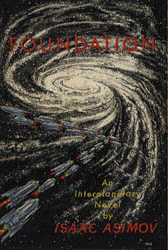
Isaac Asimov's Foundation

I have always been a fan of Asimov, so I might be a bit biased, but I have always considered this book to be an incredible book. Part of the beauty of this book is that it does not go into details of what the future will look like in terms of development of machines or other such science, but concentrates on what the society of that time will be like. In many ways, it seems like a continuation of things you can see even now (or could see if you studied the rise and falls of the great empires); using the decay caused by flattery, by too much bureaucracy, and by the presence of weak people in the position of power. You can read about how politics plays a part in everything, and how the power of mass appeal can be used to seduce the masses. In fact, if you look further, you can even relate the use of organized religion (and the terms takes on a new meaning in the book) to be used to control an entire planet (seems similar to what you can see in terms of the influence of religion in large sections of the world ?)
The book starts from the perspective of Hari Seldon, a newly arrived mathematician to the city of Trantor, the heavily settled capital of the Galactic Empire that has been in operation now for 12,000 years. Trantor is a world that has been totally built over now (although modern climatologists will argue that such a doing would totally destroy the climate of the world) and is dependent on a large amount of resources from all over for its survival. He is already getting famous as the inventor of psychohistory, which can be used to predict the future (or more accurately, as he keeps on describing, is a tool that be used to calculate the future of large masses of people). The Emperor calls him, and is not satisfied, and ultimately he is hauled up in front of the court for predicting sedition.
He manages to turn the battle by defining some of the timeframes, and proposes that he can save the future by getting an Encyclopedia Galactica built using his team, and they are moved to a small mineral-less planet called Terminus on the edge of the galaxy. Their true mission is to eventually establish a Foundation that is the core of Seldon's plan to bring order within a 1000 years. And so starts the story of the Foundation, growing out of this small set.
The story continues 50 years later with the planet being governed by the body writing the encyclopedia, not caring about what else happens. They get a visit from the neighboring provinces, one of the 4 neighboring provinces that have rebelled against the empire and become independent, but are low in technology, with no knowledge of atomics. Terminus is asked to pay tribute for protection (extortion on a planetary scale), and in lieu of minerals, to accept parceling out sections of the planet to the province and accept it as a feudal lord. A visitor from the empire is of no help. It is at the this time that Salvor Hardin, the largely powerless Mayor of Terminus shows his true skills, convincing the other provinces that the move by Anacreon is against them and winning this round. And to cement his triumph, Hari Seldon emerges in a 50 year hologram from the Time Vault and describes that the events were exactly as he expected, and that the concept of an Encyclopedia Galactica was a sham, with the true purpose being to setup the Foundation as the nucleus of a new power center.
3 decades later, the Foundation, using its vastly superior technology and knowledge of atomics, has taken over pseudo-control over the neighboring provinces through a system of science and technology transfer under the guise of a religion called Scienticism. People all over have accepted it as a valid religion, controlled by priests who are educated on Terminus and are capable of controlling the mobs on the various planets. But Terminus by itself does not have any military power of its own, instead depending on the religion to keep things under control. One person, Wiennis, the regent of Anacreon has seen through this and wants to defeat the Foundation militarily and get overall control. Towards this end, he even captures a derelict old massive Empire battleship and gets the Foundation to repair it, something that Salvator Hardin agrees to do. Hardin is under tremendous pressure from a section of his political opposition that does not like this appeasement, and they are enraged at this generosity of the Foundation. However, when Wiennis orders the attack, he finds out the true power of the religion that he endorsed. His ship, and every temple of the land is put under interdict, with the priests telling the population that Wiennis is committing blasphemy and his rebellion is defeated. However, at the end, in another emergence of Hari Seldon in the time vault, he comments about how the religion is enough for defense, but not for expansion.
These were the 2 most interesting chapters of the book, and the remaining chapters of the book talk about how the Foundation now spreads through the power of its technology and through the Merchant Princers, traders who spread the influence of the Foundation through the neighborhood, beating attempts to control this influence from spreading through means of hook or crook. The last section has an interesting story about how, when a society is hooked onto convenient and useful machines in every section of life, a war can be controlled by just denial of such machines to households in the planet.
For true science fiction adherents, this is such a book worth keeping that even buying a hardbound edition will be useful.


Hardcover


Paperback

Sunday, September 9, 2007

Ken Follett: The Pillars of the Earth

I had read numerous thrillers from Ken Follett, and then came across the book, 'The Pillars of the Earth'. This seemed a bit boring, after all this was a novel about the goings-on in the 12the century, and seemed to do with the fights between the claimants to the throne, as well as the trials and tribulations of some other people involved. But then I decided to start reading the book, and was left spell-bound. Once I finished reading the book, it seemed like an epic, integrating the lives of various claimants to power, a common but intelligent prior, penniless children of a dispossessed former earl, the current earl who is a cruel and ruthless person, and some members of the church who are as political as anybody else. Throw in the closing fight between the king and the Archbishop of Canterbury, and you have a novel set over a period of 60 years, and very gripping. The novel also covers the change in architectural styles, with the tall, sweeping, big-windowed Gothic style churches coming into prominence.
It has a number of characters, many of them with many strong characteristics, and yet none of them are perfect. All of them have their own weaknesses, and even the historical character of Thomas Becket has his own political game to play in his fight for political supremacy over the King. This is a fight that goes onto this day, where the clergy fights for political supremacy over the people's representatives, with the most profound example being Iran where a theocratic council (representing God) have supremacy over the elected people.
The novel is about a period called The Anarchy in England's history where there was a contest for the throne between Empress Maud and King Stephen, being supported by their own sets of Earls and other noblemen (all due to the sinking of the White Ship which carried the Crown Prince and other noblemen in an attempt to kill the crown prince). The sinking left a survivor, who is one of the subtle points of this movie, since a plot to get him executed for theft suborned a high Church official, a prior and an earl, a story revealed much later in a trial.
The novel starts with the story of a stonemason and builder, Tom Builder who is now without a job due to the breakup of the engagement between the Lady Aliena and the cruel and cold William Hamleigh (whom Lady Aliena turned down). Tom wanders around the forest with his son Alfred and daughter Martha. and his pregnant wife. His wife dies after giving birth, but since he cannot bring up the child, he leaves the child on his wife's grave (where the child is found by the main hero of the book, the prior Philip and brought up as Jonathan). He later meets and accepts Ellen along with her son, the red-haired Jack and settles down in Kingsbridge where Philips wants to build a cathedral. Now building a cathedral takes a large sum of money, and has a side effect of attracting a market which in turn generates revenue for the whole area, but the building of a cathedral also needs permission.
And now comes bad times for Lady Aliena and her brother Richard. They have supported Empress Maud and are considered disloyal to King Stephen, and William Hamleigh attacks the castle, arrests the earl, and rapes Aliena by threatening Richard. They are penniless, but Aliena over a period of time shows business instincts by starting to buy and sell wool, and teams up with Prior Philip to set up a market, and also falls in love with the odd Jack.
When things were starting to look up, William again turns criminal, burning the wool market, and the poor-again Aliena agrees to marry Alfred. The marriage however could not succeed, since Ellen turns up and curses the marriage. Philip's plans for the cathedral collapse when Alfred puts a stone roof instead of a wooden roof and the building collapses. Also, Aliena gives birth to a red-haired son, obviously Jack's son; and obviously Alfred turns her out. When Ellen gets to hear of this, she seeks Aliena out and tells her to go look for Jack in Europe.
Jack is in the continent, and learns how to build the wide, sweeping churches of the new style, and this is where Aliena meets him with her son. Unfortunately, Philip cannot marry them since she is still married to Alfred. After a period of time, things again change when the Philip-hater and extremely ambitious Bishop Waleran Bigod teams up with the Hamleighs to cause the downfall of the Kingsbridge market so that they can build the dream cathedral of the Hamleighs at Shiring that they had to stop because of lack of money. Aliena had taken the help of William's wife to take the castle for Richard from within. Alfred tries to rape Aliena, but is killed by Richard; however, since legally Alfred was married to Aliena, this is treated as a murder, and Richard is only safe with Philip (Richard is being chased by Willian Hamleigh who had been appointed as the sheriff). In a compromise, Richard agrees to go for the crusade, and going for a holy war will absolve him of the murder.
Things go on, while Jack has built an extremely fabulous cathedral in the new style, new to England that seems light and airy. And then one of the most important historical sequences happens, where King Henry, tired of his never-ending struggle for ultimate supremacy England instigates his knights to get rid of Becket. William joins them, and in a pretty accurate portrayal, Thomas is killed. Philips seizes the moment, and converts the confused crowd into a crowd obsessed with the 'martyring' of Becket, and into a mass movement that the king cannot even think of controlling. In one of the most important moments (closing moments), Henry atones for his crime of having contributed to the death of Thomas Becket by getting a ritual caning from the monks - an ultimate supremacy of the spiritual over the royalty.